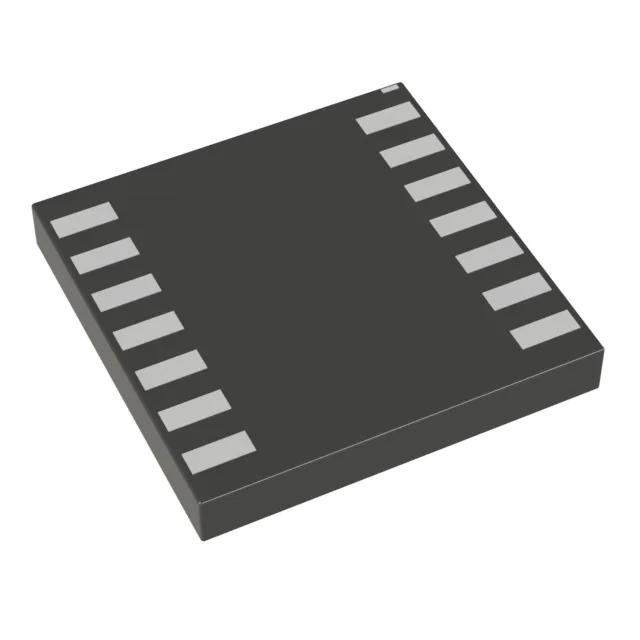
Automotive gate-drive isolator — 4 A peak, 2500 Vrms, 14-LGA
The SI8234AB-D-IM is a 2-channel digital isolator from Skyworks Solutions built with capacitive coupling technology, delivering 2500 Vrms isolation between input and output sides. The part is rated for 4 A peak output current, with asymmetric drive: 2 A source and 4 A sink. This asymmetry is deliberate — IGBT and SiC gate drivers need higher sink current to pull the gate low quickly during turn-off, reducing switching losses and Miller plateau dwell time. The 12 ns typical rise/fall time (12 ns max) supports switching frequencies well above 100 kHz in a half-bridge topology. Propagation delay is 60 ns max, matched within 5.6 ns pulse-width distortion between the two channels. Matched delay keeps the high-side and low-side gate signals aligned in a half-bridge, minimizing dead-time margin requirements. Common-mode transient immunity (CMTI) is 20 kV/µs minimum — the isolator maintains data integrity when the output side sees fast voltage swings, as happens during hard-switching events in a motor drive or DC-DC converter.
Package, supply, and approvals
Housed in a 14-VFLGA (14-LGA) package measuring 5 mm × 5 mm, the SI8234AB-D-IM is a surface-mount device supplied in tray packaging. The small footprint suits space-constrained ECU layouts where board area is at a premium. The output supply voltage range is 6.5 V to 24 V, allowing direct connection to a 12 V automotive battery bus without an intermediate regulator. Safety and market approvals include CQC (China), CSA (Canada), UR (UL-recognized, US), and VDE (Germany) — the isolator meets the isolation coordination requirements for reinforced insulation in these jurisdictions. ROHS3 compliance (exempt-free) means no restricted substances above threshold limits, suitable for lead-free solder processes used in automotive electronics assembly.
Active lifecycle — no end-of-life risk for current programs
For a production program that has already qualified this isolator into the BOM, the supply chain risk from obsolescence is zero in the near term.