66.5 kHz switching — what it means for transformer and filter design
The TEA1733T/N1,118 is a GreenChip flyback controller from NXP, switching at a fixed 66.5 kHz. That frequency sits below the 150 kHz AM radio band, so the EMI filter design is simpler — you can get through conducted emissions testing without a multi-stage LC filter on the input. The transformer core size is a trade-off: at 66.5 kHz you need a slightly larger ferrite than a 100 kHz design, but the switching losses in the external MOSFET are lower, which matters when the junction temperature is already pushing 150 °C.
75 W power ceiling — where this controller fits in a supply design
Rated for 75 W in a flyback topology, this controller covers the sweet spot for auxiliary and bias supplies in industrial gear — think 24 VDC panel power, gate-drive bias rails, or IoT gateway PSUs. The 72% duty cycle limit gives the transformer reset time, so you can run at a reasonable input voltage range without saturating the core. Output isolation is built into the control scheme, meaning the feedback loop crosses the isolation barrier through an optocoupler or a digital isolator.
Fault protection set — what is covered and what is not
The TEA1733T/N1,118 integrates current limiting, over-power protection, over-temperature shutdown, and over-voltage protection. That covers the four failure modes that kill an offline supply: a shorted output, a load dump that pushes the feedback loop past its limit, a fan failure that cooks the board, and a feedback-loop open that sends the output rail above the rated voltage. There is no under-voltage lockout hysteresis on the Vcc pin — the startup threshold is 20.6 V, and the controller runs down to 12.2 V before it resets.
Package and field-rework reality
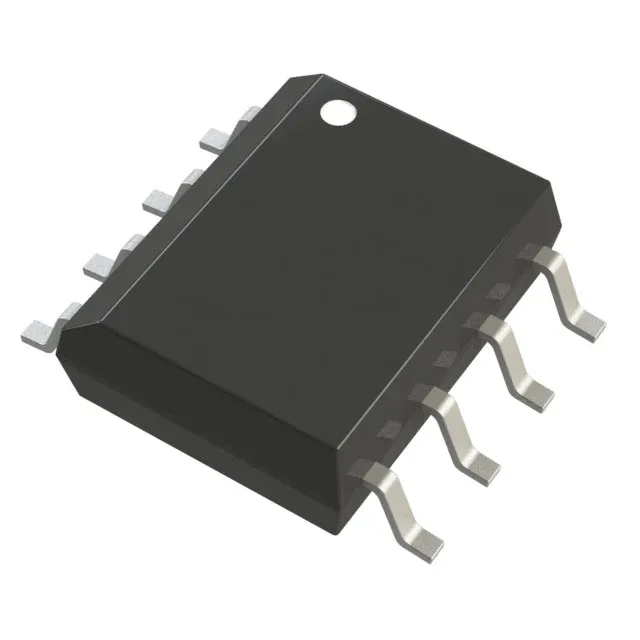
No thermal pad underneath, so a standard soldering iron or hot-air pencil works — no bottom-side preheat required. The part is marked with the full order code, so orientation is obvious from the pin-1 dot.
Active lifecycle and compliance posture
It is ROHS3 compliant, so it passes the EU RoHS exemption list without any of the restricted substances.