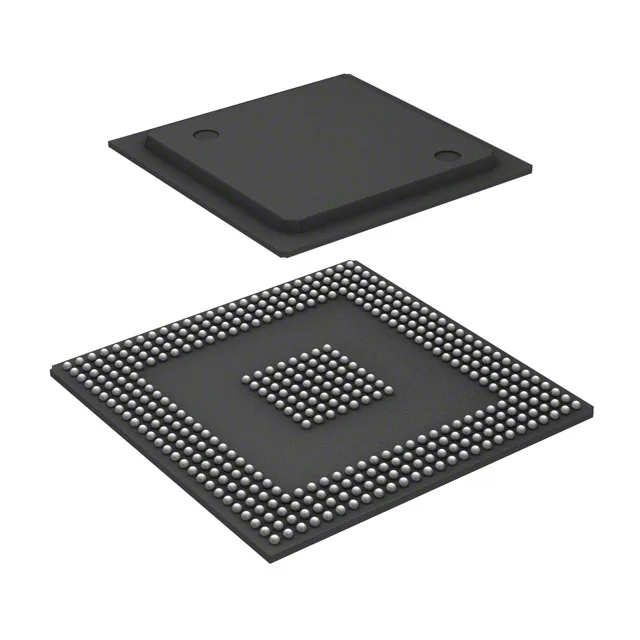
The NXP SPC5775BDK3MME2 is a 32-bit dual-core MCU from the MPC57xx family, built around two e200z7 cores running at 220 MHz. It carries 4 MB of program Flash and 512K x 8 of RAM, with 293 I/O lines brought out to a 416-MAPBGA package (27x27 mm). This is a safety-architecture part — the dual-core layout supports lockstep or split-mode execution for ASIL-B through ASIL-D applications, which is why you see it specified in automotive powertrain, electric-vehicle inverter control, and industrial servo-drive designs where a single-point fault can't be allowed to corrupt the control loop.
Peripheral set and analog front-end
The peripheral list includes DMA, LVD, POR, and Zipwire inter-core communication. On the analog side there are two eQADC modules handling 40 channels at 12-bit resolution — enough to sample multiple current-sense shunt resistors and rotor-position sensors in a single control cycle. Connectivity covers CANbus, FlexCAN, Ethernet, LINbus, SCI, and SPI, so the part can act as a vehicle-domain gateway or a multi-protocol industrial controller without an external bridge chip.
Supply voltage spans 3 V to 5.5 V.
Housed in a 416-MAPBGA (27x27 mm), this is a fine-pitch BGA — not a hand-rework-friendly package unless you have a decent reflow station and a stencil. The 293 I/O count means the ball map is dense; verify the pad layout against the supplier device package drawing before committing the board layout. Orientation is marked on the package, but with a BGA this size, a misaligned reflow is a board scrap. Plan for X-ray inspection on the first build.
No official second-source alternate is listed in the MPC57xx family for this exact density and package, so plan for single-sourced procurement on this BOM line.