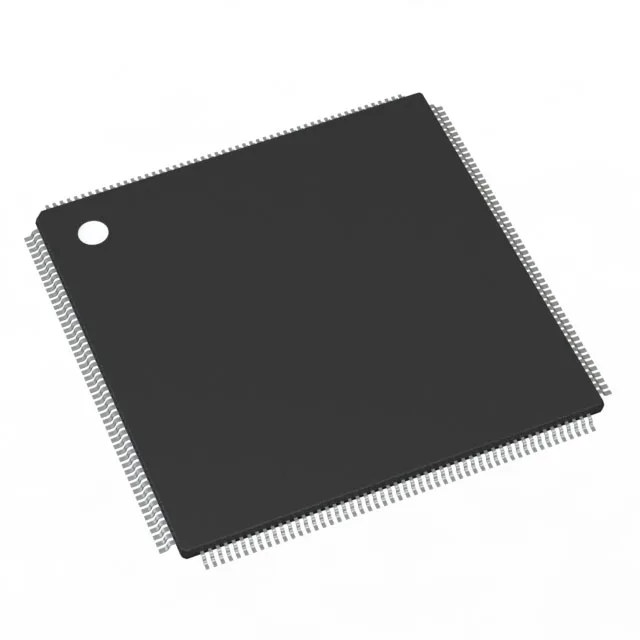
The NXP SPC5645BF0VLT1R is a 32-bit single-core microcontroller from the MPC56xx Qorivva family, built around the e200z4d Power Architecture core clocked at 120 MHz. It carries 2 MB of Flash program memory, 160K x 8 of RAM, and 64K x 8 of EEPROM on-die — enough headroom for complex real-time control loops and calibration tables without external storage.
2 MB Flash and 160K RAM — sizing the firmware and data budget
The 2 MB Flash (2M x 8) is sized for applications that carry large firmware images, multiple calibration maps, or OTA staging areas. The 160K x 8 RAM supports moderate data buffering and stack depth; designs that run heavy CAN message queues or sensor fusion algorithms should budget the RAM against worst-case queue depth.
Connectivity and I/O — CAN, LIN, SPI, and 177 GPIO
With CANbus, LINbus, SCI, and SPI on the peripheral list, this MCU can serve as a gateway node aggregating multiple automotive buses. The 33-channel 10-bit ADC and 10-channel 12-bit ADC handle analog feedback from temperature sensors, potentiometers, and current shunts without an external converter.
It's reworkable with a hot-air station and flux — the exposed leads are easy to inspect and touch up.