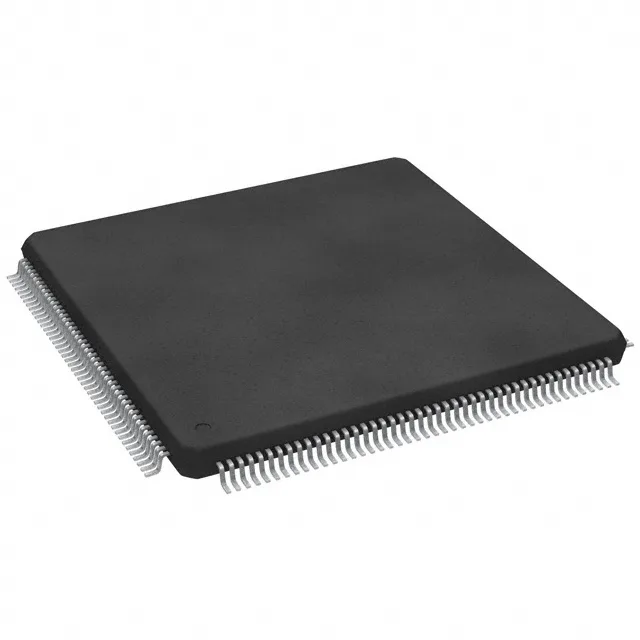
The NXP SPC5606BF1VLU6 is a 32-bit single-core MCU from the MPC56xx Qorivva family, built around the e200z0h Power Architecture core clocked at 64 MHz. It carries 1 MB of Flash program memory, 80K x 8 RAM, and 64K x 8 EEPROM — enough firmware and parameter space for engine-management ECUs, transmission controllers, or industrial gateway modules that need to retain calibration data across power cycles. The supply range from 3 V to 5.5 V lets this MCU interface directly with 5 V sensors and actuators common in automotive and industrial environments, reducing the bill for level-shifting components. Operating temperature spans -40 to 105 °C, so it handles under-hood heat soak and cold-crank conditions without a heatsink. The internal oscillator trims one external component from the BOM, though a precision crystal is still advisable if the CAN bus needs tight timing tolerance.
ADC bank and peripheral set — what the 29+5 channels mean for sensor fusion
The data converter block provides 29 channels of 10-bit ADC and 5 channels of 12-bit ADC. In a typical engine-control layout, the 10-bit group can handle throttle position, manifold pressure, and temperature sensors, while the higher-resolution 12-bit channels serve the oxygen sensor or knock sensor where finer granularity matters. The DMA and PWM peripherals offload the core for waveform generation and data movement — useful for fuel-injection timing or motor-drive commutation.