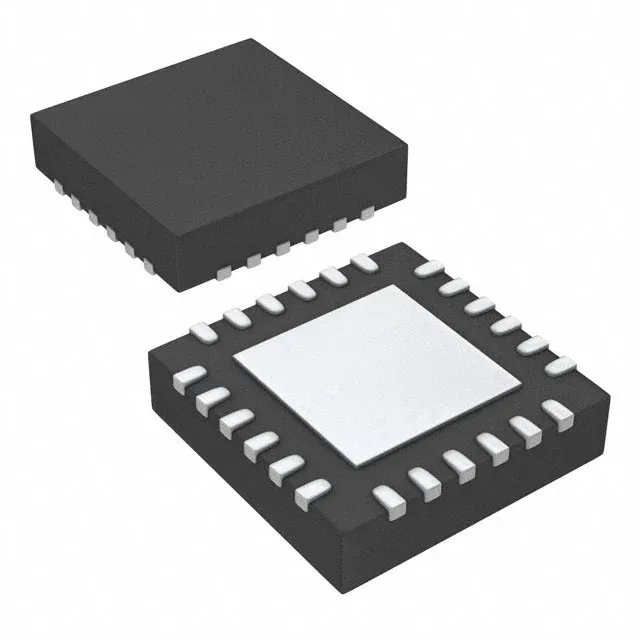
I2C GPIO expansion for the BOM
The PCA8575BS,118 is an NXP I²C-bus GPIO expander providing 16 push-pull I/O lines in a 24-HVQFN (4x4 mm) package. It sits between a host controller and a bank of discrete signals — buttons, LEDs, relays, or status indicators — where the MCU's own GPIO count has run out.
What the 16 I/O and 400 kHz clock mean on the bench
Sixteen push-pull I/O lines — each can sink 25 mA or source 100 µA. The sink current is enough to drive a standard LED directly; the source side is limited to high-impedance loads or pull-ups. For relay or buzzer drive, buffer externally. The I²C clock rate tops out at 400 kHz — standard Fast-mode. At that speed the bus timing budget includes the expander's internal propagation delay plus the RC time constant of the SDA/SCL trace capacitance. A 10 kΩ pull-up to Vdd is the usual starting point; drop to 4.7 kΩ if the bus capacitance exceeds 200 pF. A POR (Power-On Reset) feature ensures the I/O default to inputs at power-up — no floating outputs driving loads before the host configures the direction registers. The interrupt output pulls low when an input changes, letting the host poll only on demand rather than continuously scanning the bus.
Temperature grade and supply rails for the deployment envelope
Surface-mount in a 24-VFQFN exposed-pad package.
Sourcing and compliance posture
RoHS3 compliant.