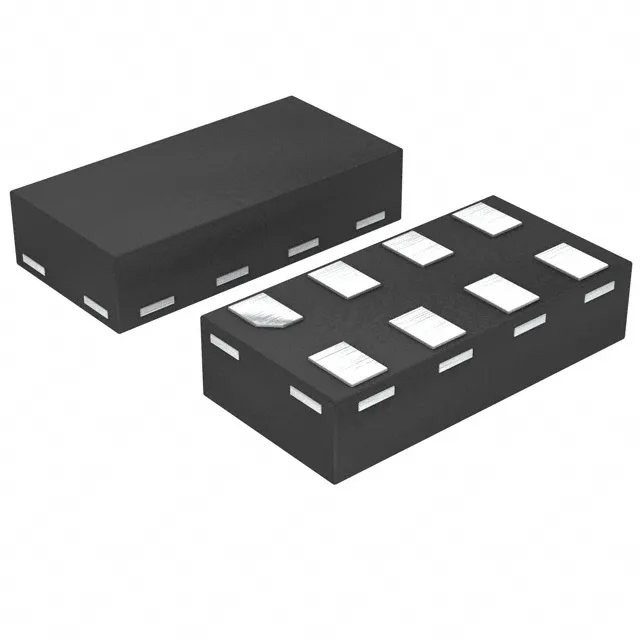
Package and board-fit for the 8-XSON
The NX3L2T66GT,115 lands in an 8-XFDFN package, specifically the 8-XSON SOT833-1 variant with a 1.95x1 mm footprint. That is a very small outline — the 0.5 mm pitch demands a controlled solder-paste stencil and careful pad design to avoid bridging on the narrow leads.
750 mOhm on-resistance and what it means for signal integrity
The channel-to-channel matching is 20 mOhm, so the two SPST legs track each other closely, which matters for differential or stereo routing. Crosstalk is specified at -90 dB at 100 kHz — that is strong isolation between channels for a dual switch in a tiny package. The -3 dB bandwidth of 60 MHz confirms it passes baseband analog signals cleanly up through video or fast ADC input multiplexing.
Supply range, switching speed, and charge injection
The turn-on time is 28 ns max, turn-off 20 ns max — fast enough for multiplexing sensor channels at moderate scan rates. Charge injection is 6 pC typical. That is the glitch the switch injects into the signal path when it toggles; for a 10 kOhm source impedance, 6 pC translates to roughly 60 µV of step, which is acceptable for 12-bit systems but worth budgeting in a precision 16-bit front-end.
Temperature range and leakage
Off-channel leakage is 10 nA max, so the switch does not load the signal path significantly even at high temperature where leakage typically rises. Channel capacitance is 35 pF per port (CS(off), CD(off)). That capacitance, combined with the source impedance, sets the settling time — a 10 kOhm source into 35 pF gives a 350 ns RC time constant, so budget at least 1 µs settling for 12-bit accuracy.
No pin-compatible second-source is documented in the NXP family for this exact package and on-resistance target.