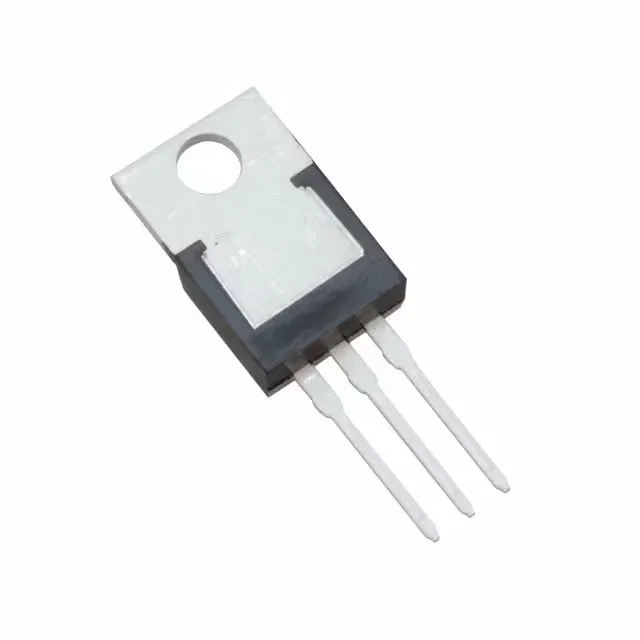
RF power transistor for HF/VHF linear stages
The NXP MRF101AN is an LDMOS RF power transistor delivering 115W output across 1.8 MHz to 250 MHz. It is designed for 50V nominal supply operation and achieves 21.1 dB gain at the 100 mA test current. The TO-220-3 package simplifies heatsinking and board mounting in industrial RF generators, broadcast transmitters, and amateur radio power amplifiers.
21.1 dB gain at 50V and 100 mA means a single stage can bring a typical 1W driver to over 100W output — useful for reducing driver chain complexity in 100W-class linear amplifiers. The 115W output is the rated power at the specified test condition; actual usable power in a 50-ohm system depends on heatsinking, matching network loss, and the peak-to-average ratio of the modulation scheme. The 133V rated voltage gives headroom for load mismatch transients without immediate breakdown.
Frequency range and application fit
Covering 1.8 MHz to 250 MHz, the MRF101AN spans the 160m through 2m amateur bands. The LDMOS structure offers better linearity and gain flatness than bipolar RF power transistors across this range, with lower temperature sensitivity of the bias point.
TO-220-3 is a standard through-hole power package with the drain tab as the centre lead. Mount with a mica or sil-pad insulator and thermal compound to a heatsink rated for the dissipation. The 10 µA off-state leakage at 133V is negligible; the real thermal load is the product of drain current and drain-source voltage during conduction. For 115W RF output at 50% efficiency, expect roughly 115W dissipation — size the heatsink accordingly for the ambient temperature and duty cycle.
For dual-source planning, NXP offers other LDMOS parts in the same power class — confirm pin-compatibility and matching network requirements before substituting.