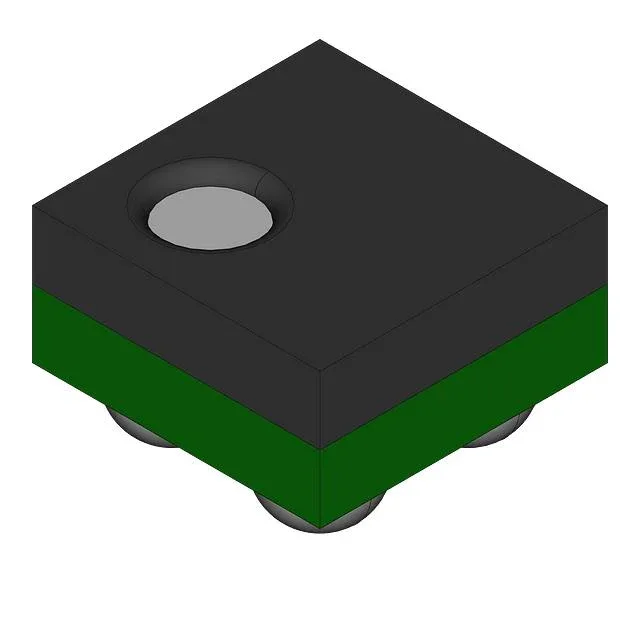
Low-pressure differential sensor for controlled environments
The NXP MPXC2012DT1 is a piezoresistive differential pressure sensor built around a Wheatstone bridge output. It is designed for low-pressure sensing applications at 1.45 PSI (10 kPa) full-scale, with a millivolt-level output spanning 0 mV to 25 mV when excited at 10 V. The temperature-compensated die and barbless port make it a fit for clean, dry gas measurement in indoor equipment — think HVAC filter monitoring, air-flow sensing in medical ventilators, or pressure drop across a HEPA filter.
What the 0 mV to 25 mV output means for your signal chain
At 10 V excitation the full-scale output is only 25 mV. That is a tiny signal — you will need an instrumentation amplifier with a gain of 100 to 200 to bring it into the 0–5 V range of a typical ADC. The bridge output is ratiometric: if your supply drifts, the output drifts with it, so a precision reference for the ADC is worth the board space. The temperature compensation is built in, but it is only specified over the 15°C to 40°C band; outside that window the offset and span will walk.
Package and mounting — through-hole 4-SSIP
The MPXC2012DT1 comes in a 4-pin single-in-line (4-SSIP) module with PC-pin termination for through-hole mounting. The barbless port means there are no barbs for push-on tubing — you will need a compression fitting or a glued nipple for the air line. The port style and the thin, narrow package are sized for PCB edge mounting, with the pressure port facing off the board edge. No surface-mount option exists for this part; it is a hand-insert or wave-solder-only device.
For new designs this is a safe call, though the narrow temperature range means you should verify the ambient conditions in the end product stay inside the 15°C to 40°C window. No official second-source or pin-compatible equivalent is listed; if you need dual sourcing, you will be qualifying an alternate package or signal-conditioning circuit on your own.