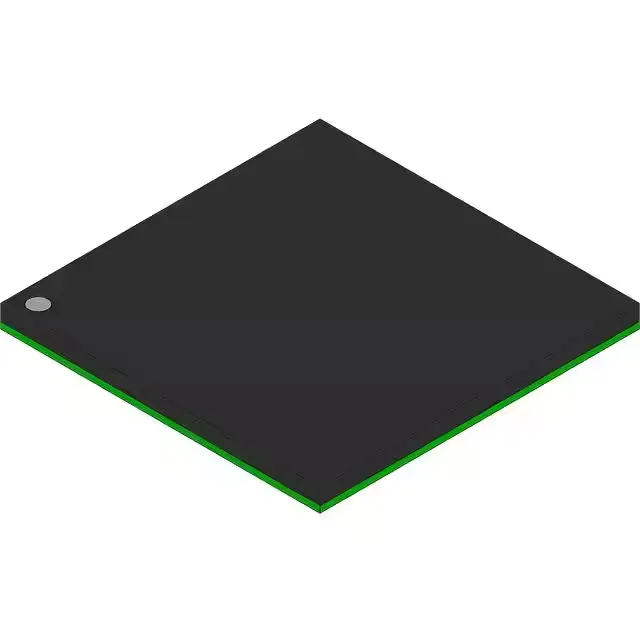
The NXP MCF53016CMJ240J is a 32-bit ColdFire V3 microcontroller clocked at 240 MHz, packing 128K x 8 of SRAM and 83 general-purpose I/O lines in a 256-ball MAPBGA (17x17 mm) package. It runs from 1.08 V to 3.6 V across the industrial temperature range of -40°C to 85°C. This part is ROMless — there is no internal Flash for code storage, so every design must pair it with external non-volatile memory (serial NOR or parallel Flash) over the EBI/EMI or SPI interface. Typical applications include industrial control, Ethernet-connected gateways, and motor-drive front-ends where the ColdFire V3 core handles protocol stacks and real-time loops while external memory holds the firmware image.
ROMless reality — no field updates without external Flash
Because the program memory type is ROMless, the firmware lives off-chip. That means the BOM needs a separate serial NOR or parallel Flash device, and any field-update strategy has to account for the external memory's endurance and write speed. For a repair bench, if the board's external Flash is corrupted, swapping just this MCU won't bring the board back — the Flash image needs to match. On new designs, the ROMless architecture gives flexibility to choose the exact Flash density and interface (SPI, Quad-SPI, or parallel EBI) without being locked to an on-chip memory size.
That Ethernet MAC is the key differentiator for designs that need a single-chip gateway or industrial IoT node — no external Ethernet controller needed, just a PHY and magnetics.