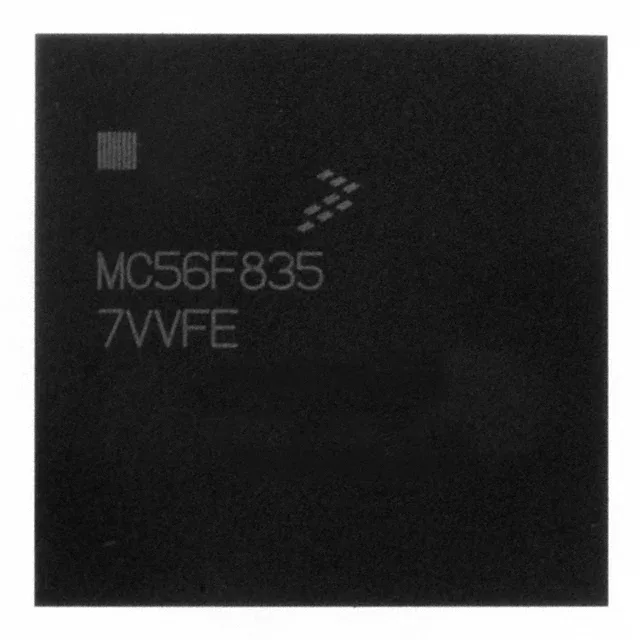
The NXP DSP56F807VF80E is a 16-bit digital signal controller that combines a 56800 core processor running at 80 MHz with on-chip Flash program memory of 120 KB and 4K x 16 words of RAM. It belongs to the 56F8xx series, a family of hybrid MCU/DSP devices built for real-time control applications that need both microcontroller peripherals and DSP math throughput. Typical deployment includes motor drives, power inverters, industrial servo controllers, and automotive actuator modules where the CANbus interface and the 16-channel 12-bit ADC handle sensor feedback and network communication on a single chip.
The 80 MHz clock rate on the 56800 core determines how fast the part can execute a control-law iteration.
Memory and connectivity for the BOM
120 KB of Flash program memory (organized as 60K x 16) is sized for mid-complexity control firmware — a typical sensorless FOC algorithm plus CANopen stack fits, but a full EtherCAT slave implementation would overflow. The 4K x 16 RAM is the working data space; watch the stack and buffer allocation if the application uses multiple CAN message objects or large lookup tables. On the connectivity side, the CANbus module, along with SCI (UART) and SPI, covers the three most common serial links in industrial and automotive networks. The 32 general-purpose I/O pins are enough for a handful of digital sensors, relay drivers, and status LEDs, but not for a large HMI panel.
The DSP56F807VF80E is supplied in a 160-ball MAPBGA package (15x15 mm body), surface-mount only.
No official second-source alternate is listed in the 56F8xx family, but the 160-MAPBGA footprint is shared across multiple Flash/RAM density options within the series, providing a pin-compatible upgrade path without a board spin.