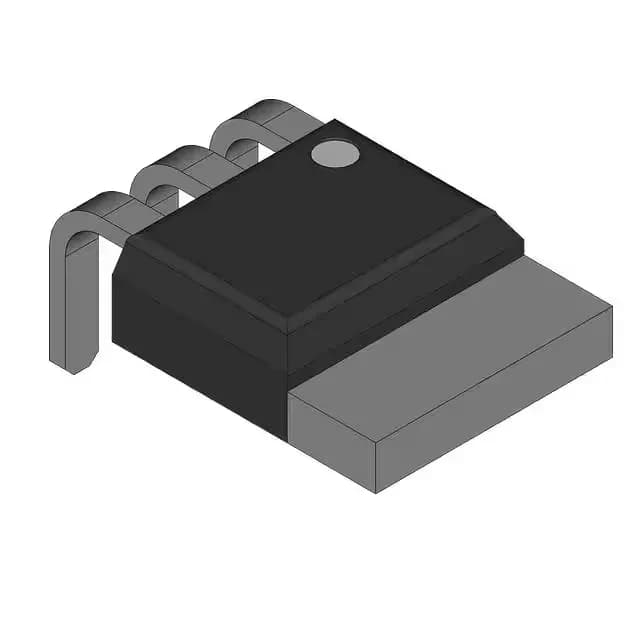
It comes in a through-hole I2PAK package and is qualified to AEC-Q101, making it suited for automotive power-train, motor-drive, and high-current switching applications where the junction temperature can reach 175°C.
5.2 mOhm on-resistance — conduction loss in high-current paths
At 120 A the I²R loss is about 75 W — the 349 W power-dissipation rating at case temperature gives enough thermal headroom when the part is properly heatsunk. The 10 V drive voltage is the recommended gate level to achieve the lowest on-resistance; the ±20 V Vgs absolute maximum allows some margin for gate-drive overshoot.
Gate charge and input capacitance — drive requirements
The gate charge is 180 nC at 10 V, and the input capacitance is 11810 pF at 25 V drain-source. These numbers set the gate-driver current needed for a given switching frequency. A 10 A gate driver, for example, can charge the gate in about 18 ns — fast enough for hard-switching converters in the 50–100 kHz range. Slower gate drive reduces EMI but increases switching loss; the 180 nC figure lets you calculate the trade-off for your switching speed.
Automotive-grade qualification and temperature range
AEC-Q101 qualification means this part has passed the automotive stress tests for reliability — temperature cycling, high-temperature reverse bias, and humidity.