RF gain block for automotive and industrial ISM-band stages
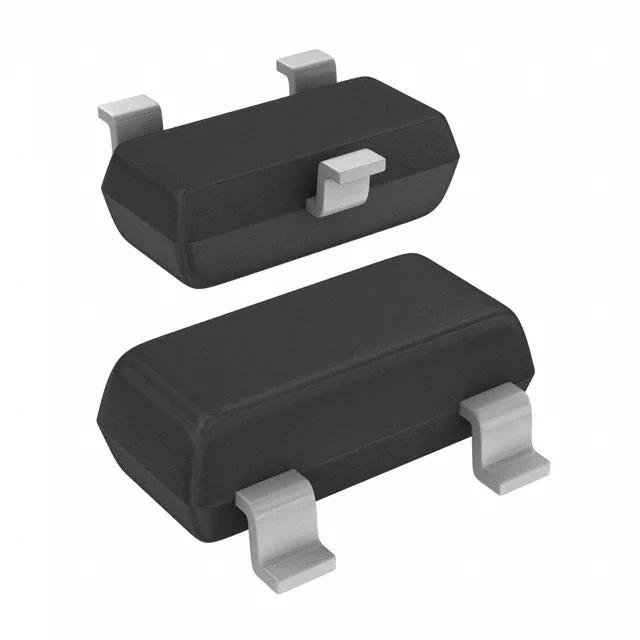
The NXP BFU530AR is an NPN silicon RF transistor in a SOT-23 (TO-236AB) package, designed for low-noise amplifier and driver stages up to 11 GHz transition frequency. The 12 V collector-emitter breakdown and 40 mA maximum collector current give enough headroom for +10 dBm output stages without pushing the die hard.
The BFU530AR carries AEC-Q101 qualification and an operating junction temperature range of -40 to 150 °C. That puts it squarely into automotive under-hood and chassis-domain RF stages — tire-pressure monitor transmitters, keyless-entry receivers, and 77 GHz radar sensor pre-drivers — where the 150 °C junction rating covers the hot-soak condition on the engine bay firewall. For industrial designs, the same temperature margin simplifies derating calculations when the transistor sits near a 70 °C ambient power supply or a motor-drive heatsink.
SOT-23 footprint and thermal reality
The 450 mW power dissipation limit is the package ceiling, not the die limit; at 150 °C junction and 25 °C ambient the thermal derating leaves about 250 mW usable in still air. If the stage runs at 10 mA and 8 V (80 mW DC), the junction rise is roughly 50 °C above ambient — well inside the 150 °C absolute maximum.
DC gain and bias stability
The DC current gain (hFE) is specified at 60 minimum at 10 mA collector current and 8 V collector-emitter — a typical bias point for a 900 MHz LNA. This tight hFE floor means the bias network can use a simple emitter resistor without worrying about part-to-part variation pulling the collector current out of the low-noise sweet spot. The 11 GHz fT also tells you the device has enough fT margin at 900 MHz to keep the gain flat across the band without external compensation.