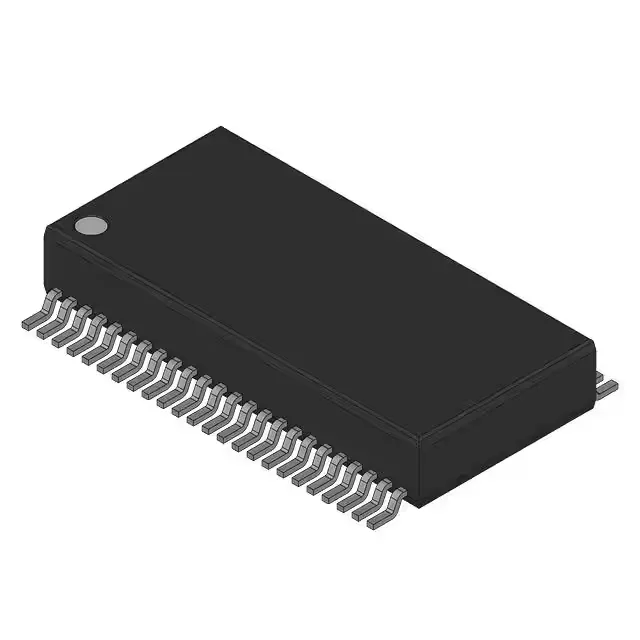
16-bit register with 300 MHz edge capture
The NXP 74LVC16374ADL,112 is a 16-bit D-type flip-flop built from two 8-bit elements, each clocked on the positive edge and driving tri-state non-inverted outputs. With a 300 MHz clock frequency, it captures bus-width data at a rate that keeps up with fast memory interfaces and datapath pipelines without adding wait states. Supply voltage spans 1.65 V to 3.6 V, so the same part works in a 1.8 V core logic domain or a 3.3 V peripheral bus — no level translator needed at the interface.
48-SSOP footprint and hand-solder viability
Housed in a 48-BSSOP package with 0.295-inch body width and 0.635 mm pitch, the 74LVC16374ADL,112 is a surface-mount part that a rework station or even a careful hand-solderer can handle — the leads are visible and accessible, unlike a QFN or BGA. The supplier device package is 48-SSOP, which matches standard land patterns for that footprint. Operating temperature from -40°C to +125°C covers industrial and automotive cabin environments, so the register holds state across a cold start or a hot enclosure.
Low static draw and fast propagation
Quiescent current sits at 20 µA typical — negligible for battery-backed or always-on logic where the register stays powered but idle most of the time. Each output drives 24 mA source or sink, enough to fan out to multiple CMOS loads or drive a LED directly through a resistor. Maximum propagation delay is 5.4 ns at 3.3 V with a 50 pF load, meaning the data settles well within one 3.3 ns clock period at 300 MHz, leaving timing margin for the next stage.