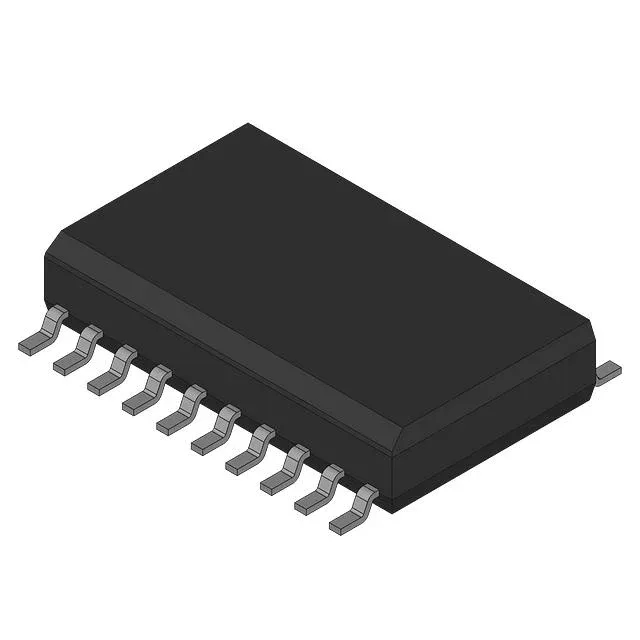
What this 74HC9115D/S400118 buffer does on your board
The 74HC9115D/S400118 is a 9-element, non-inverting buffer from the 74HC logic family. Each element is a single-bit buffer with a Schmitt-trigger input and an open-drain output. The open-drain output lets you wire multiple outputs together for a wired-OR configuration, and it also enables level translation—pulling the output to a different voltage rail than the supply via an external pull-up resistor. The Schmitt-trigger input cleans up slow or noisy edges, which helps maintain signal integrity in industrial environments or across long PCB traces. Housed in a 20-SOIC (7.50 mm body width) surface-mount package, it fits standard SOIC-20 footprints. The low-side sink capability is 5.2 mA per output; the high-side drive is not specified because the open-drain output only pulls low—the pull-up resistor determines the high-level current.
Open-drain outputs and wired-OR flexibility
Because the output is open drain, multiple 74HC9115D/S400118 buffers can share a common pull-up resistor. This wired-OR connection is useful for interrupt lines, bus-request signals, or any shared line where any driver can assert a low. The pull-up resistor value sets the rise time and the high-level voltage, so you can match the output to a 1.8V, 2.5V, 3.3V, or 5V receiver independent of the buffer's VCC. The 5.2 mA sink current per output is sufficient for driving TTL inputs, small LEDs, or the base of a transistor switch. If you need more drive, buffer multiple elements in parallel—the package holds nine independent buffers.
Schmitt-trigger inputs: noise immunity and edge conditioning
The Schmitt-trigger input has built-in hysteresis, typically a few hundred millivolts. This prevents false triggering on slow-rising signals from RC oscillators, sensor outputs, or long cables. In a motor-drive environment where PWM edges couple noise onto control lines, the hysteresis rejects glitches shorter than the propagation delay.