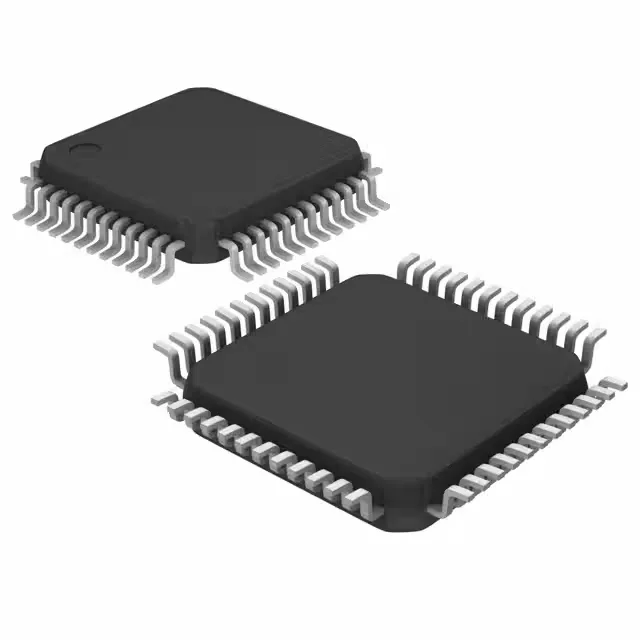
The NXP LPC11U68JBD48E is a 32-bit ARM Cortex-M0+ microcontroller running at 50 MHz, with 256 KB of Flash and 36 KB of RAM. It is part of the LPC11Uxx series.
The 50 MHz clock is the ceiling for the Cortex-M0+ pipeline. For a USB CDC or HID application, that is enough headroom to service the 12 Mbps full-speed endpoint while polling a couple of I²C sensors and updating a PWM output. If your control loop needs to run above 50 kHz or you are bit-banging a high-speed protocol, this part will be tight — but for the typical mix of serial communication, ADC reads, and GPIO toggling, 50 MHz is a comfortable fit.
Memory budget and field-reprogrammability
256 KB of Flash holds a moderate firmware image — think a USB stack, a Modbus RTU slave, and a handful of application routines. The 36 KB RAM (organized as 36K x 8) gives enough buffer space for USB packets and a couple of I²C transaction queues. The Flash is in-system programmable via the USB or UART bootloader, so firmware updates in the field are possible without a programmer — useful for a panel retrofit or a firmware patch on site. The internal oscillator keeps the part running without an external crystal for many applications, though the USB peripheral will need a precise clock source for full-speed operation.
Industrial temperature and on-chip peripherals
The 8-channel 12-bit ADC is enough for reading a few analog sensors or a potentiometer — not for precision measurement, but adequate for panel feedback and threshold detection. The DMA controller can move data between peripherals and RAM without CPU intervention, which helps keep the 50 MHz core from being bogged down by serial traffic.