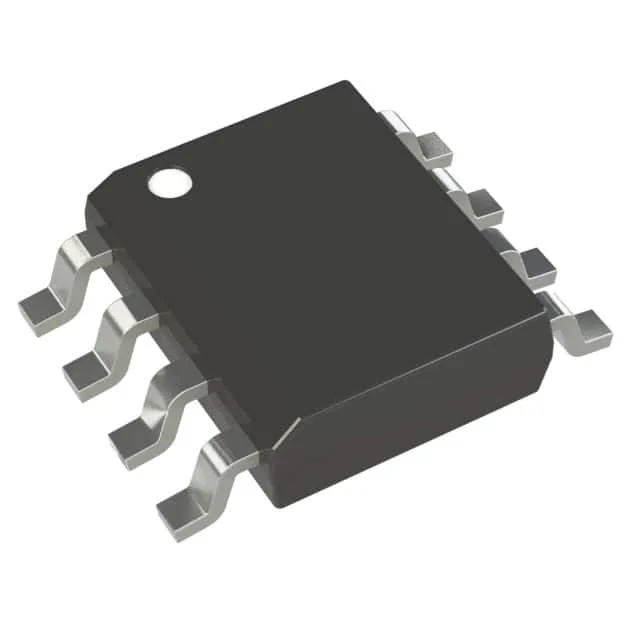
10 kHz GBP at 600 nA — the ultra-low-power signal chain
The RE46C311S8F is a single-supply, single-channel general-purpose op-amp from Microchip Technology, optimized for applications where supply current is the primary constraint. The rail-to-rail output swing preserves dynamic range at low supply voltages, and the 3 mV input offset (typical) is adequate for DC-accurate signal conditioning in this power tier.
600 nA supply — what it buys the BOM
At 600 nA quiescent current, this op-amp extends battery life in applications where the signal chain is always active. For a 240 mAh coin cell, the op-amp alone draws roughly 0.25% of capacity per year from the quiescent current, leaving nearly all the energy budget for the sensor, MCU, and wireless link. The trade-off is the 10 kHz gain-bandwidth: signals above a few kilohertz will see significant attenuation, so this part fits DC and low-frequency tasks — thermistor conditioning, photodiode amplification with a large feedback capacitor, or bandgap reference buffering — not audio or high-speed ADC drivers.
Rail-to-rail output swings to within millivolts of each rail at light loads, and the 27 mA output current per channel can drive modest loads — a reference input, a comparator, or a low-power ADC — directly. The 0.003 V/µs slew rate reflects the nano-power bias; expect 10% to 90% rise times on the order of hundreds of microseconds for a 1 V step, consistent with the 10 kHz GBP.
Package and environment
The -10°C to 60°C operating temperature range targets commercial and indoor environments — office equipment, portable consumer devices, and controlled industrial enclosures — not automotive or extended-industrial duty.
The part is ROHS3 compliant. For production BOMs, this removes the urgency to qualify a second source now, though the ultra-low-power op-amp market has several pin-compatible alternatives from other vendors if dual-sourcing is required for supply resilience.