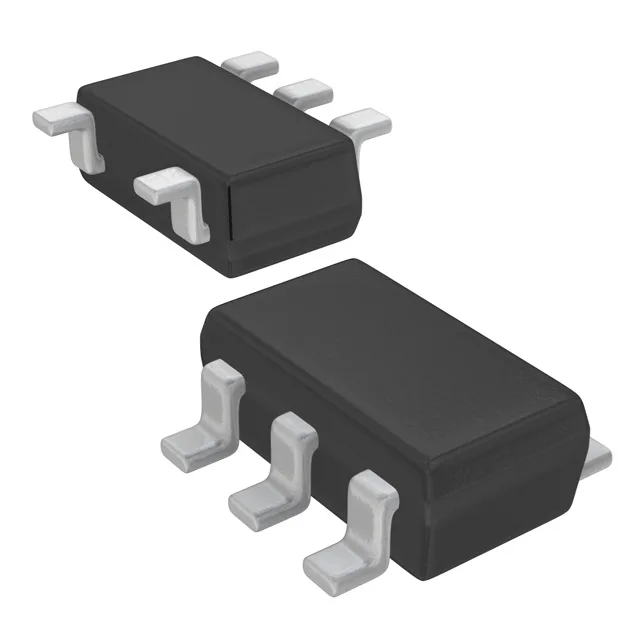
80 kHz zero-drift amplifier — precision where bandwidth is secondary
The Microchip MCP6V11UT-E/LT is a single-channel zero-drift operational amplifier in a 5-pin SC-70-5 package, built for applications where DC accuracy and low power matter more than speed. Its auto-zero topology holds input offset voltage to 8 µV typical and virtually eliminates drift over temperature and time — the kind of spec that makes a thermocouple or strain-gauge front end stable without periodic calibration. The 80 kHz gain-bandwidth product and 0.03 V/µs slew rate confirm this is a DC-precision part, not a general-purpose or high-speed amplifier. Rail-to-rail output swing preserves dynamic range at low supply voltages.
The 8 µV input offset voltage is the headline precision spec. In a 100x gain stage that offset becomes 0.8 mV at the output — negligible for most sensor interfaces, but the real value is the zero-drift architecture that keeps offset from walking with temperature. The 5 pA input bias current suits high-impedance sources like pH probes or photodiode transimpedance stages where bias current error would otherwise dominate. Output drive is rated 17 mA per channel, enough to swing a 10 kΩ load rail-to-rail or drive the input of a successive-approximation ADC directly. The 7.5 µA quiescent current means this amplifier adds less than 0.1% to the sleep budget of a battery-powered sensor node running at 10 µA total draw.
SC-70-5 footprint and supply range
The SC-70-5 package (also known as SOT-353) occupies roughly 2.0 mm × 2.1 mm — one of the smallest footprints for a single op-amp. The 1.6 V minimum supply means it runs from a nearly depleted Li-ion cell, and the 5.5 V maximum covers 5 V ±10% rails with margin. Surface-mount assembly is standard; no exposed pad, so thermal performance depends on the board copper and ambient airflow.
This is a safe selection for a new BOM line — no last-time-buy planning needed, no risk of a forced redesign mid-production.