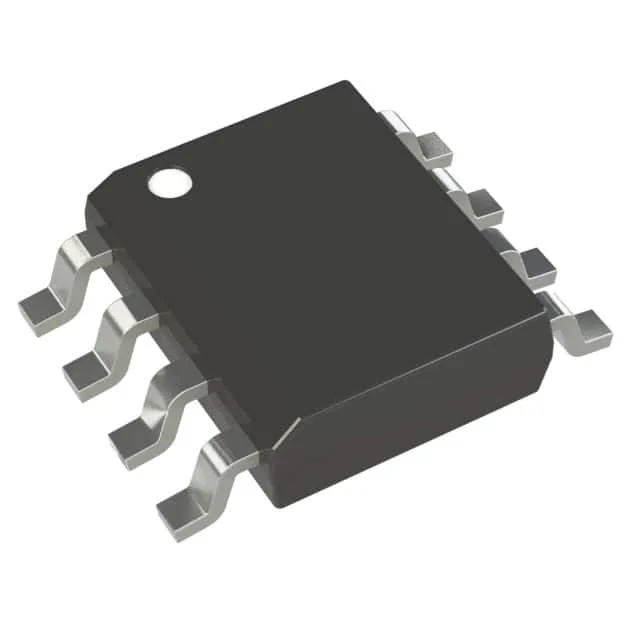
The Microchip MCP6542T-E/SN is a dual general-purpose comparator in an 8-SOIC package, built for applications where the supply rail can't be pinned to a tight tolerance. It runs from 1.6 V to 5.5 V single supply (or dual supplies if you need a split rail), so it fits into 1.8 V logic systems, 3.3 V sensor interfaces, and 5 V industrial control boards without a separate regulator. The 8 µs propagation delay (max) puts it in the slow-but-predictable category — fine for threshold detection, overvoltage/undervoltage lockout, and window comparators, but not for high-speed PWM feedback or zero-crossing at switching frequencies above a few tens of kilohertz. The headline number is the 1 µA maximum quiescent current per channel. That is the reason to pick this part over a standard LM393 (which pulls about 400 µA per comparator). The trade-off is speed: the LM393 propagates in about 1.3 µs, while the MCP6542 takes 8 µs. If your signal edges are slow (millisecond-scale sensor outputs, RC time constants), the 8 µs delay is invisible.
Output type and input characteristics — no surprises on the board
The output stage is CMOS push-pull with rail-to-rail swing, and it is also TTL-compatible. That means you can drive a logic gate input directly without a pull-up resistor. The push-pull output also handles capacitive loads better than an open-drain stage — useful when the comparator feeds a long PCB trace or a microcontroller input with a few picofarads of pin capacitance. Input bias current is 1 pA typical at 5.5 V, which is essentially zero for most divider networks. The input offset voltage is 7 mV max at 5.5 V — not a precision comparator, but fine for threshold detection where the hysteresis (6.5 mV internal) dominates the switching accuracy. The 70 dB CMRR and 80 dB PSRR are respectable for a general-purpose part; you will not see the threshold shift more than a millivolt or two across the supply range.
Temperature range and environment — field-service perspective
No exposed pad, so no thermal-via stencil needed — just the usual 100 nF decoupling cap close to the supply pin.
Microchip lists the MCP6542T-E/SN as Active product status.