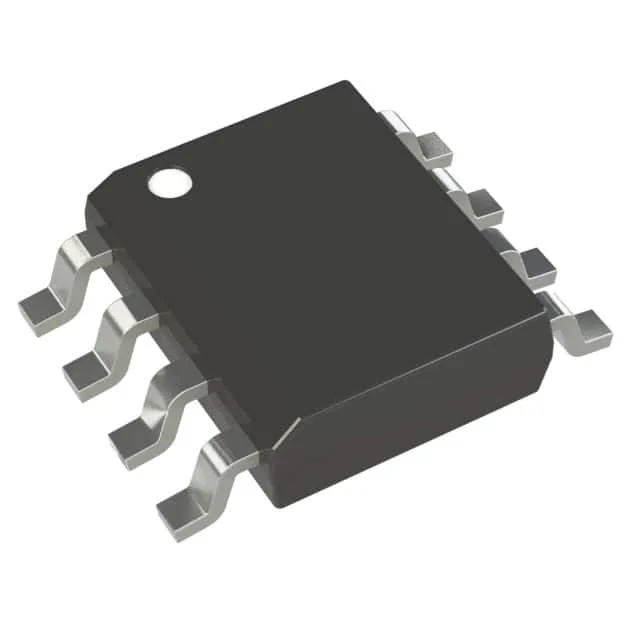
The 600 nA op-amp that won't drain your battery
The Microchip MCP6142T-I/SN is a dual general-purpose op-amp built for the low-power corner of the design space. Its headline figure is 600 nA of supply current per channel — that's the kind of draw that lets a sensor node run for years on a coin cell. The trade-off is a 100 kHz gain-bandwidth product and a 0.024 V/µs slew rate, so you're not driving audio or fast ADC inputs with this part. It's for conditioning slow signals — thermocouples, strain gauges, photodiodes — where the amplifier's own quiescent current needs to be a footnote in the power budget. The supply voltage span runs from 1.4 V to 6 V, so it works straight off a single alkaline cell or a regulated 5 V rail. Output is rail-to-rail, which at 1.4 V supply means you get nearly the full swing into a high-impedance load — important when the ADC reference is the supply itself.
Active, ROHS3, and in an 8-SOIC
Microchip lists the MCP6142T-I/SN as Active, so there's no end-of-life clock ticking on this part for new designs. It's ROHS3 compliant, which clears it for EU-market builds without an exemption review. That covers most indoor and outdoor equipment that isn't bolted to an engine block.
A 100 kHz gain-bandwidth product with a 0.024 V/µs slew rate tells you this op-amp is meant for DC and low-frequency AC signals. If you need to buffer a 1 kHz sine wave at unity gain, it's fine — the closed-loop bandwidth is 100 kHz. But try to swing 1 V peak-to-peak at 10 kHz and the slew rate limits you to about 0.024 V/µs × (1/10 kHz) ≈ 2.4 V peak-to-peak theoretical, but the GBWP caps the gain-bandwidth product, so you won't get full swing at that frequency. In practice, use this part for signals below 1 kHz if you need any gain.