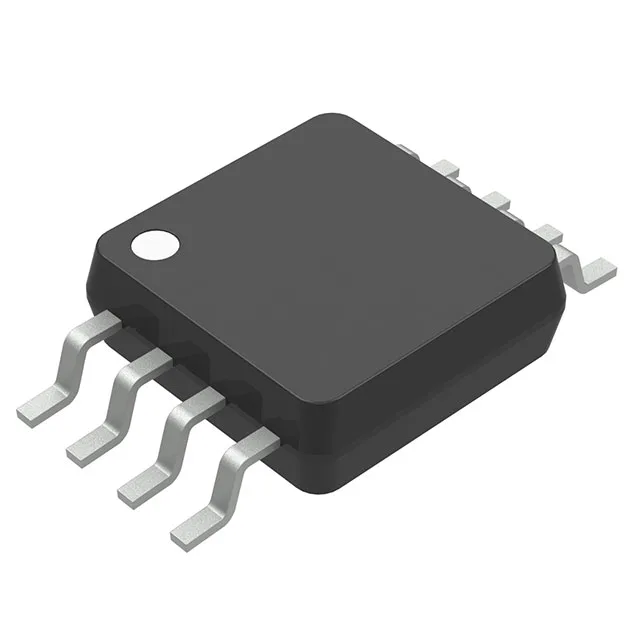
Nanopower dual op-amp for always-on and battery-tethered analog
Input bias current is 1 pA, so high-impedance sources — pH probes, photodiodes, high-value resistor dividers — connect directly without a separate buffer. The 3 mV input offset voltage is typical for a CMOS general-purpose amplifier at this power level; if your application needs sub-millivolt precision, plan for a trim or a chopper-stabilized alternative.
600 nA per channel — the power budget decider
The 600 nA supply current per amplifier is the headline rating that separates the MCP6142 from Microchip's own higher-speed siblings. The MCP6272T-E/SN draws 200 µA per channel and delivers 2 MHz GBWP with a 0.9 V/µs slew rate; the MCP6281T-E/SN draws 400 µA per channel for 5 MHz GBWP. Both are better fits for signal chains above 10 kHz, but neither can run for years on a coin cell in an always-on sensor node. The MCP6142 trades speed for three orders of magnitude lower quiescent current — a trade that makes sense when the amplifier spends most of its life idle or processing sub-1 kHz signals.
Active lifecycle — no LTB flag for new BOMs
Microchip lists the MCP6142T-E/MS as Active. The part is ROHS3 compliant. For a new design requiring a nanopower dual op-amp in an 8-MSOP package, this part carries no short-lifecycle risk and can be qualified into production without an obsolescence watch item on the BOM.
Package and supply — footprint and rail planning
The supply range from 1.4 V to 6 V covers single-cell alkaline (1.5 V nominal) through 2-cell Li-ion (7.2 V nominal, though the 6 V absolute maximum means a 2-cell Li-ion at full charge exceeds the rating — derate to a 1-cell Li-ion or a regulated 5 V rail).