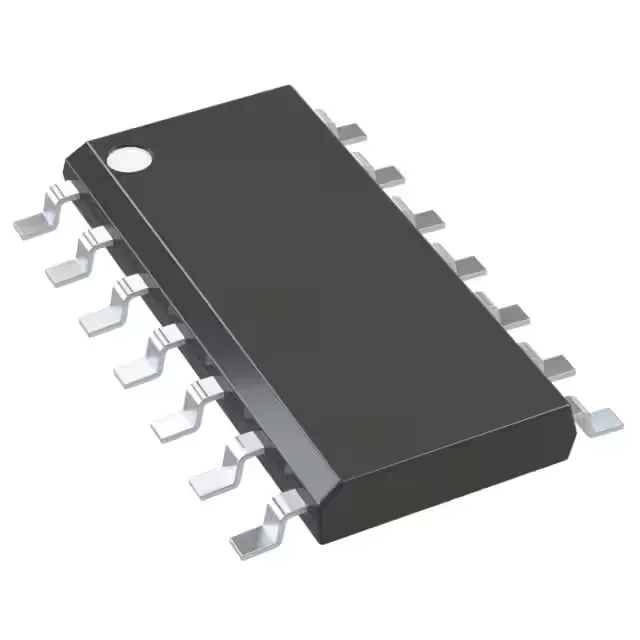
Quad CMOS op amp for low-frequency, low-power signal chains
The Microchip MCP609T-I/SL is a quad CMOS operational amplifier in a 14-SOIC package, designed for applications where low power consumption and rail-to-rail output swing are priorities over bandwidth. Each of the four amplifiers draws a typical supply current of 18.7 µA total, making it a strong fit for portable or loop-powered instruments where every microamp is budgeted.
What the 155 kHz GBWP and 0.08 V/µs slew rate mean for your design
The 155 kHz gain-bandwidth product means you can expect a closed-loop gain of 10 to hold a flat response up to about 15.5 kHz. Beyond that, the open-loop gain rolls off. The 0.08 V/µs slew rate limits the large-signal output swing to roughly 40 kHz peak-to-peak at 5 V — fine for audio sub-bands, thermocouple outputs, or strain-gauge bridges, but not for audio line-level or PWM reconstruction. If your signal chain needs faster settling or wider bandwidth, the MCP6V17T-E/MS zero-drift amplifier runs at 80 kHz GBWP with 0.03 V/µs slew rate — actually slower — so the MCP609 is the higher-bandwidth pick. The MCP6142T-I/SN general-purpose quad runs at 100 kHz GBWP and 0.024 V/µs; again the MCP609 is the faster option in the family.
Supply current and output drive — the power budget decision
At 18.7 µA total for four amplifiers (about 4.7 µA per channel), the MCP609T-I/SL sits in the micropower tier. The combination of low quiescent current and moderate output drive makes it a candidate for multi-channel sensor interfaces where the op amp must also bias an ADC input or a comparator threshold.