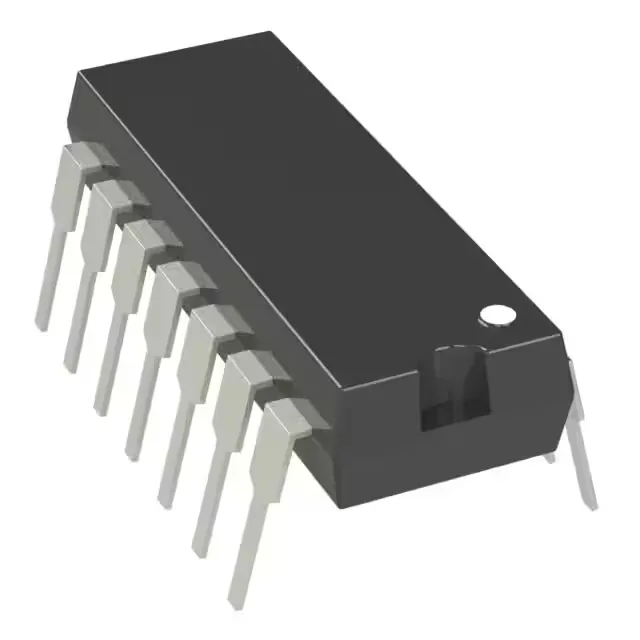
The MCP609-I/P is a quad CMOS rail-to-rail output op-amp from Microchip, in a 14-pin DIP package. Its 155 kHz gain-bandwidth product and 0.08 V/µs slew rate place it firmly in the micropower, low-frequency signal-conditioning space — think thermocouple amplifiers, battery-voltage monitors, and piezo-sensor buffers where the signal bandwidth stays under a few kilohertz. The 18.7 µA total supply current (four channels) means each amplifier draws under 5 µA, making this a natural fit for loop-powered 4-20 mA transmitters or battery-backed sensor nodes that run for years on a coin cell.
Rail-to-rail output, CMOS input — where the limits live
The CMOS input stage gives 1 pA typical input bias current, so you can use high-value feedback resistors (1 MΩ or more) without offset drift from bias current.
Supply range and package — breadboard to production
The supply span runs from 2.5 V minimum to 6 V maximum, covering single-cell Li-ion (3.0 V to 4.2 V) and standard 5 V logic rails. For production, the through-hole package limits automated assembly speed compared to SOIC or TSSOP, but for low-volume, high-reliability or breadboard-first designs the DIP is still the practical choice.