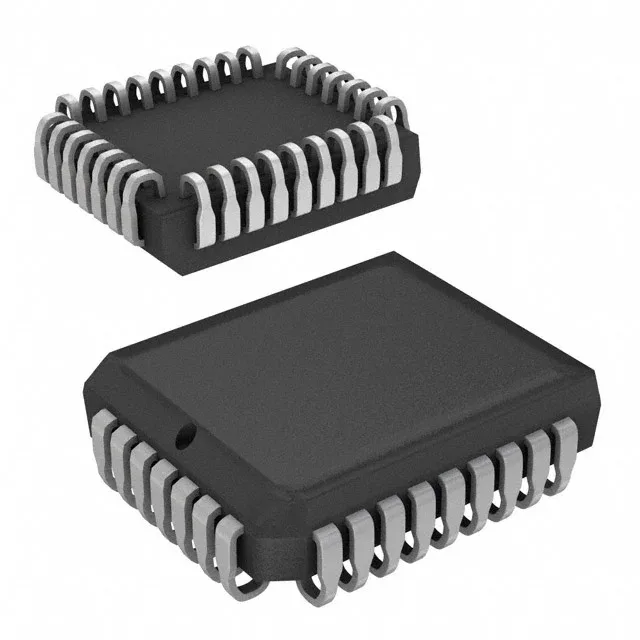
The Microchip AT28BV64B-20JU-T is a 64Kbit (8K x 8) parallel EEPROM organized as a single 8-bit-wide byte array. For a 16 MHz 8051-class MCU or a 40 MHz CPLD, 200 ns leaves enough margin for address decoding and bus turnaround without inserting wait states. The parallel interface means eight data lines and up to 13 address lines, so it suits designs that already have a parallel memory bus — legacy industrial controllers, telecom line cards, or FPGA configuration stores — rather than the two-wire I²C bus used by the AT24C series.
The supply range of 2.7V to 3.6V covers the 3.3V rail common in late-1990s through current designs. The 2.7V floor is useful for battery-backed applications where the rail may sag during discharge — a 3.0V lithium primary cell still keeps the EEPROM in spec until nearly exhausted.
32-PLCC package — rework and footprint considerations
The 32-PLCC package with J-leads is a surface-mount form factor that can be hand-soldered with a hot-air station or reflowed. The J-lead profile creates a small solder fillet under the body, which makes visual inspection of the heel joint tricky — an X-ray or angled borescope helps. The 13.97x11.43 mm body is a standard PLCC-32 footprint; the J-leads are less prone to tombstoning than gull-wing leads, but the part sits low, so cleaning flux from under the body requires a good solvent flush.
The 85°C ceiling is typical for industrial-grade EEPROMs; if your design needs 105°C or 125°C, look at the AT28BV64B-20JU (no -T suffix) or automotive-grade siblings.
Write cycle time and endurance
That is the time the device is busy after a write command — the host must wait or poll the data-polling flag before starting the next write. For a 64 Kbit part, rewriting the entire array at 10 ms per byte takes about 82 seconds worst-case. If your application does frequent block updates, consider a serial EEPROM like the AT24CS64-MAHM-T (I²C, 5 ms page write) for faster throughput on a two-wire bus.
For dual-sourcing, the AT24CS64-MAHM-T is a 64Kbit serial EEPROM in a different package and interface — not a pin-for-pin replacement, but a functional alternative if the board can accommodate an I²C bus and a smaller UDFN-8 package.