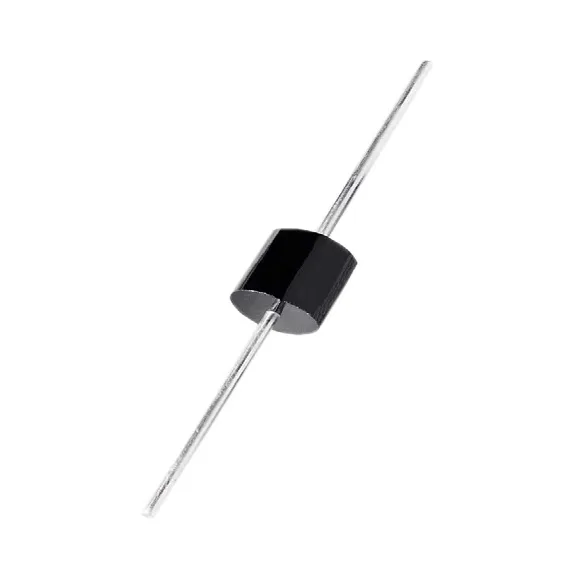
5000-watt peak pulse rating — what that surge budget means
The 5KP15CA-HRA: A lightning-surge or inductive kick transient dumps energy into the diode, the TVS goes into avalanche at its breakdown voltage, and the clamped voltage is what the downstream ICs survive. The 15 V standoff voltage sets the working rail: the part idles off until a transient exceeds that threshold, then it clamps hard and resets when the event clears. The breakdown sits at 16.7 V minimum, and at peak pulse the clamping ceiling is 24.4 V — the downstream circuitry never sees more than that regardless of how much surge energy is incoming.
HRA screening — high-reliability grade within the 5KP family
The HRA suffix marks the high-reliability screened grade — a step above standard commercial TVS in the Littelfuse 5KP-HRA series. The -55°C to 175°C operating temperature range supports deployment in thermally demanding environments: power supplies, motor controls, industrial instrumentation, anywhere a transient event carries real energy. This is not a commodity clamp; the screening grade matters when the board has to survive field events rather than just pass bringup.
P600 axial package — through-hole mounting and rework path
The P600 axial body mounts in standard through-hole fashion — compatible with wave or hand solder. The leadform is the same as every other P600 TVS, so the pad layout is a known quantity and the part does not require any special tooling to install or replace. That matters for board rework: a failed TVS in the field gets swapped with a soldering iron and flux, no hot-air specialty tip required.