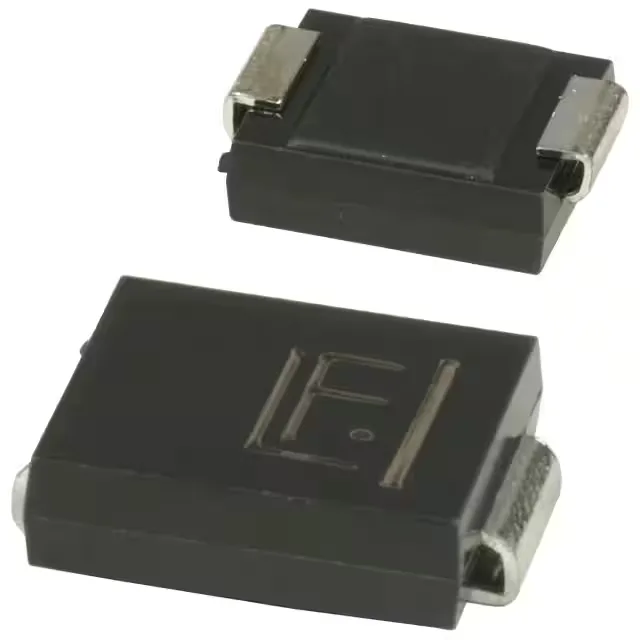
What the voltage hierarchy means
The 1.5SMC9.1C: The reverse standoff voltage of 7.78V is the working DC rail the protected node normally sees; the minimum breakdown of 8.17V is where the device begins conducting; and the clamping voltage of 14.07V at 113.4A peak pulse is the maximum the downstream circuit experiences during a surge event. For a 5V or 12V rail, the 7.78V standoff gives comfortable headroom above the nominal rail while keeping the clamping level well within the withstand rating of most downstream ICs. A faster waveform like 8/20µs delivers the same energy in less time, which can push the clamping voltage higher; the datasheet peak pulse power curve shows the derating behaviour across different pulse shapes.
Temperature and package fit
The junction temperature rating of -55°C to 150°C places this part in the industrial and automotive temperature band — the upper limit is set by the junction, not the ambient, so the thermal resistance from junction to ambient (θJA) in the actual board layout determines how much margin remains at high ambient temperatures. The unidirectional polarity means it protects a positive-going transient relative to ground — it does not clamp negative transients, only the reverse polarity absolute maximum. For bidirectional protection or AC-line work, a bidirectional TVS or a pair of unidirectional devices back-to-back is required.
Sourcing status and lifecycle
For an existing board design the part is supported through independent distribution channels; a board spin to a current-series alternative is the recommended path for new designs. Confirm the exact alternative through Littelfuse parametric search or an FAE discussion — the 1.5SMC series covers a wide standoff voltage range, and a near-equivalent with an active status may share the same footprint and clamping behaviour.