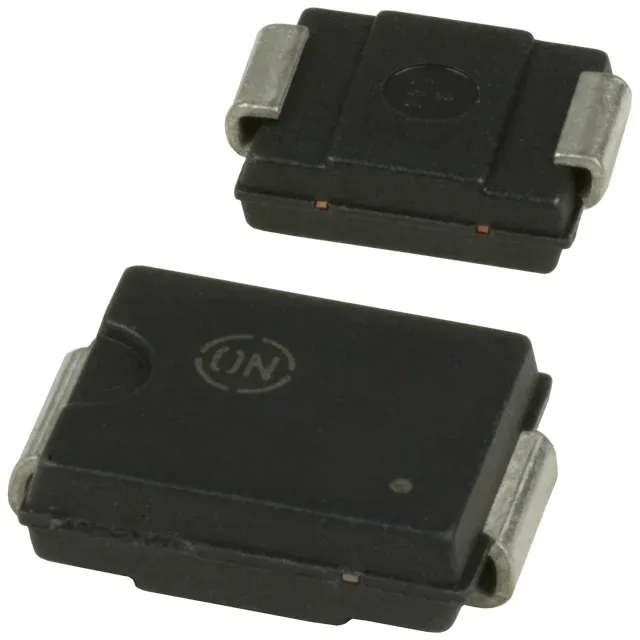
What the 1.5SMC7.5AT3G is and what it does
The 1.5SMC7.5AT3G is a unidirectional Zener-type TVS (transient voltage suppressor) from Littelfuse's 1.5SMC series — the package is DO-214AB (SMC), rated for surface-mount assembly on a standard reflow profile. It clamps voltage spikes on a single unidirectional signal or power rail, protecting downstream components from EOS (electrical overstress) events.
Clamping performance and what it means for circuit protection
With a typical reverse standoff of 6.4 V, the device sits quiescently below the line it protects. When a transient forces the line above the 7.13 V minimum breakdown threshold, the TVS turns on and clamps the peak to no more than 11.3 V at 132 A peak pulse current — so the downstream IC or fet sees a bounded voltage spike rather than an uncontrolled overstress event. The 132 A peak pulse rating at the clamping voltage is the limiting factor for surge survivability — a larger surge current compresses the clamping voltage further up the IV curve, so system-level testing against the applicable surge standard (IEC 61000-4-5, for example) determines whether this part's 1.5 kW rating is the right fit for the exposure class at the board level.
Junction temperature and deployment environment
The datasheet derating curve must be consulted to confirm the safe operating area under repeated pulses. Marked as general-purpose, the 1.5SMC series is the workhorse line for board-level protection on telecom, instrumentation, and industrial control rails — the unidirectional polarity means it connects with cathode to the protected rail and anode to ground, not reversed.
Any engineering team evaluating a substitute must work from the same series footprint (DO-214AB SMC) and voltage window (6.4 V standoff, ~7 V breakdown) to maintain the same clamping performance — but without an official cross-reference the equivalence must be validated against the actual IV curve, peak pulse rating, and clamping voltage at the design's surge current level.