What the voltage ratings mean for your rail
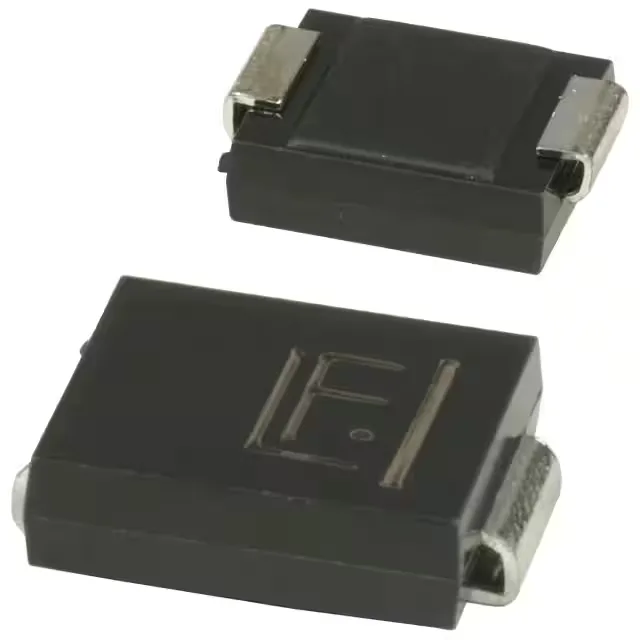
The 1.5SMC7.5 is a unidirectional Zener-type TVS diode in the Littelfuse 1.5SMC series, housed in the DO-214AB (SMCJ) surface-mount package — the most common SMC package choice for 1500W TVS devices. The reverse standoff voltage of 6.4 V sets the working rail; the part is invisible to the circuit until a transient exceeds that threshold. Minimum breakdown of 6.75 V means the device turns on hard when the rail climbs above that point, clamping the voltage at 11.87 V maximum under a 134.5 A peak pulse (10/1000 µs waveform). That clamping ceiling is what the downstream load sees during the event — the 5.47 V differential between standoff and clamping is the let-through margin the designer budgets against.
Peak pulse capability and thermal margin
The 134.5 A peak pulse current and the associated 1500 W peak pulse power rating define the transient energy the device survives without degradation. Because this is a unidirectional device, it protects one polarity only — any reverse polarity event on the protected rail passes through the TVS forward conduction path and may exceed the device's thermal limits. Confirm the rail polarity before committing to this variant.
Sourcing status and what it means for the BOM
Independent distribution is the primary sourcing channel; lot-specific availability and full traceability are confirmed at RFQ. The 1.5SMC series itself remains a standard Littelfuse family, so alternative voltage points in the series may offer a direct fit if the rail voltage allows a nearby standoff value.