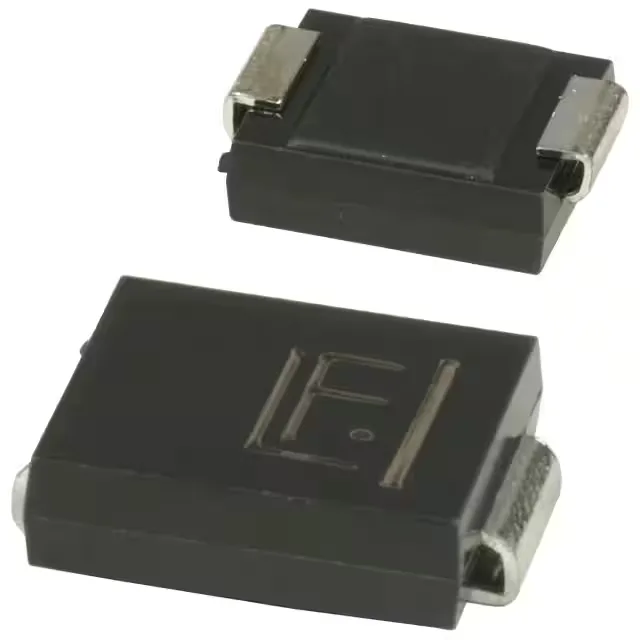
What the 1.5SMC6.8C actually does in a circuit
This is a unidirectional Zener-based TVS (transient voltage suppressor) — the 'C' suffix confirms bidirectional configuration across one channel. The 5.8 V typical reverse standoff is the working voltage — below it the device leaks quietly and does nothing, which is exactly what a properly biased TVS should do when the bus is clean.
Peak pulse and clamping — the 1500 W number
1500 W peak pulse rating defines the surge energy the device can absorb once without degradation — it is a survival rating, not a continuous rating. The 144.8 A peak pulse current is the clamping-mode current corresponding to that energy envelope at the test waveform. When selecting a TVS for a given bus voltage, the standoff (5.8 V typ,) sets the normal operating bias; the clamping voltage (11.03 V max,) is what the downstream IC sees during the event. That 11.03 V ceiling must sit below the absolute-maximum input rating of whatever it protects.
Package, mounting, and assembly
The DO-214AB (SMCJ-style) package is a standard SMD body with a wide foot — the cathode bar is the wide pad, which is the thermal and electrical common. Tape-and-reel packaging suits high-volume SMT pick-and-place. The operating junction temperature extends to 150 °C, which gives headroom in sealed or thermally demanding enclosures — the junction-to-ambient derating curve in the Littelfuse 1.5SMC series datasheet is the sizing document for thermal pad layout.
What the 'no power line protection' flag means
The Power Line Protection field reads No — this is a signal-level or low-power secondary protection TVS, not a main-line AC or high-current DC bus clamp. For a 5.8 V standoff bus the clamping voltage of 11.03 V sits comfortably below most 12 V rail absolute-maximum ratings, but the 1500 W surge rating is a single-event spec. Repeated transients above the peak pulse rating will shift the Zener characteristic — budget a TVS replacement in the service manual if the end equipment sees frequent surge events.