What the ratings mean for a 12V rail
The 1.5SMC12C: Its 10.2V reverse standoff voltage sits below the nominal rail, so the diode stays out of conduction during normal operation. When a surge pushes the line above 10.8V (the minimum breakdown point,), the device starts conducting and clamps the peak at 17.54V while shunting 91A of 10/1000µs pulse current.
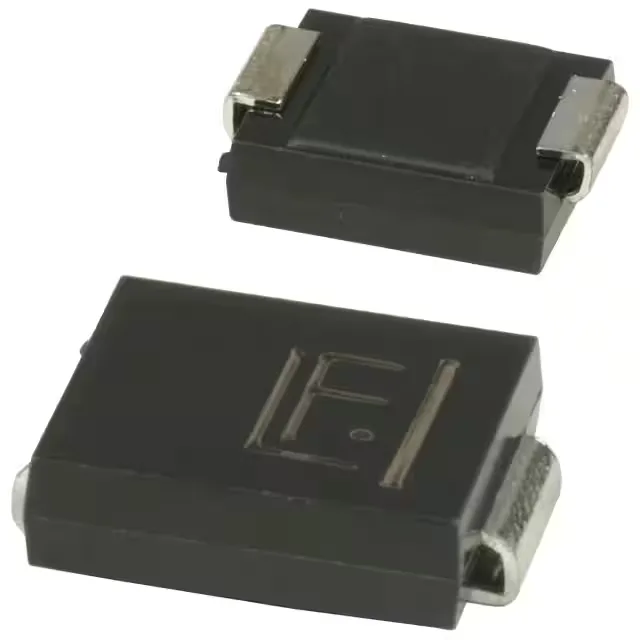
Housed in a DO-214AB (SMC) package with a supplier device package designation of DO-214AB (SMCJ), this surface-mount TVS occupies a standard footprint shared across the 1.5SMC family. The 1.5SMC series uses a common cathode marking scheme; the bidirectional variant like this one carries no polarity band, so the reel label is the only orientation reference until the part is soldered.
Lifecycle reality — obsolete, sourced to order
Littelfuse lists the 1.5SMC12C as obsolete. Because the 1.5SMC series shares a common DO-214AB footprint and the same 1500W peak pulse rating across breakdown voltages, a functional replacement exists within the same family at a different voltage point if the 10.2V standoff is not load-bearing. For designs that can tolerate a slightly higher or lower clamp threshold, a sibling in the 1.5SMC family with the same package and power rating is a drop-in candidate — no board spin required.
If your schematic calls for a unidirectional part with the cathode band oriented to the rail, this bidirectional device will clamp both polarities equally but will not provide the asymmetric low-impedance path to ground that a unipolar TVS offers for positive surges. Confirm the circuit's surge polarity requirement before substituting. The 10/1000µs pulse current rating of 91A is the peak current the device can withstand once — repetitive surges at this level will degrade the junction. For applications with frequent transients (motor drives, solenoid banks), derate the peak pulse power per the manufacturer's pulse derating curve, which is not reproduced here but is standard for the 1.5SMC series.