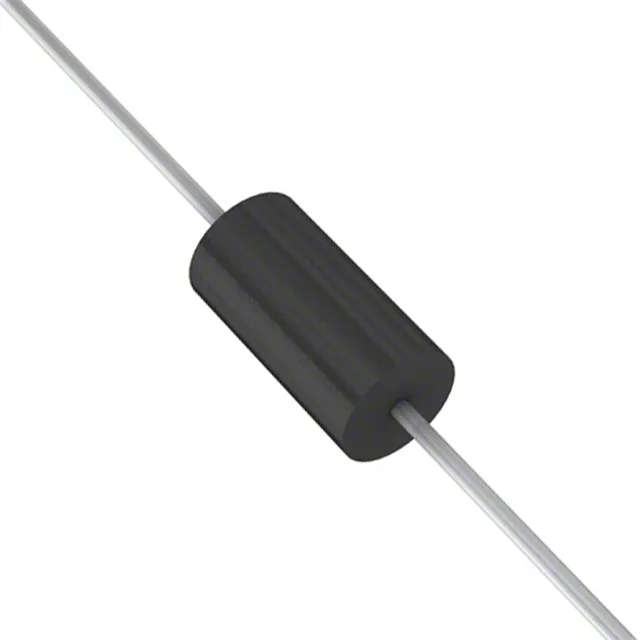
The 1.5KE300C: Its 434.7 V clamping voltage (max at Ipp) defines the protection ceiling — a transient exceeding this level is clipped, but the energy must stay within the pulse-power rating or the junction fails. Housed in a DO-201AA (DO-27) axial-lead through-hole package, it mounts into plated through-holes on the PCB — the lead bends absorb mechanical strain during wave-solder assembly, and the body stands off the board for convection cooling. The 256 V reverse standoff voltage means the diode is effectively open at normal rail voltage up to that level, only conducting during a transient event.
Clamping voltage and pulse current — what the ratings mean for the protection design
For a 256 V rail, the TVS triggers at the breakdown voltage (270 V min) and clamps at 434.7 V — the downstream components must withstand this peak for the pulse duration. The 1500 W rating is derated at elevated ambient temperatures per the manufacturer's pulse-derating curve — above 25°C the peak power must be reduced proportionally.
Obsolete — sourcing through independent distribution
The 1.5KE300C is listed as Obsolete by Littelfuse. For a BOM line already qualified to this TVS, the existing footprint and electrical performance are locked — the 1.5KE series shares the same DO-201 package across voltage variants, so a replacement from the same family (e.g., a different voltage clamp) would require a re-spin of the protection design. No pin-compatible second source from another manufacturer is recorded for this exact order code.