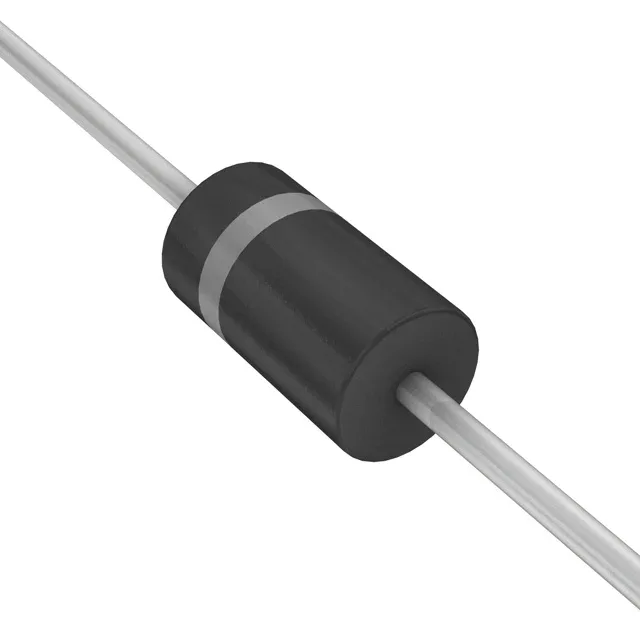
1500 W peak pulse, 27.7 V clamp — what the ratings mean for your rail
The 1.5KE20ARL4G: Reverse standoff is 17.1 V, meaning the diode draws negligible leakage at normal operating voltage up to that level. Breakdown starts at 19 V minimum, so the device stays off until the transient pushes past that threshold.
Obsolete — sourcing through independent channels
Littelfuse lists the 1.5KE20ARL4G as obsolete. The DO-201AD axial package and through-hole mounting are standard for this power class, so a functional equivalent from another supplier (same package, same voltage and power rating) can be cross-referenced without a board spin, but no pin-compatible direct replacement is published by Littelfuse.
Temperature range and deployment context
Operating junction temperature spans -65°C to 175°C, covering most industrial and automotive under-hood environments. The wide range means the clamping voltage shifts with temperature — the 27.7 V figure is at 25°C; at 175°C the breakdown voltage rises roughly 0.1%/°C, so budget margin if your rail sits near the clamp ceiling at high ambient. General-purpose application classification means it fits power-supply input protection, DC bus clamping, and signal-line transient suppression where unidirectional clamping is acceptable.