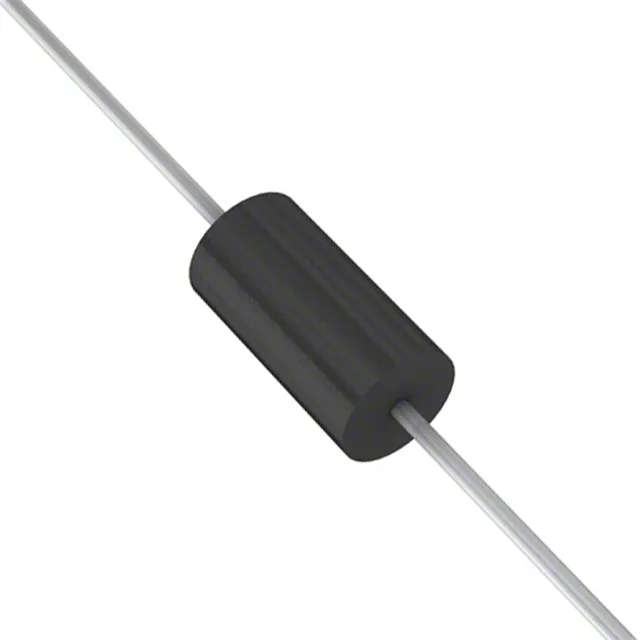
1500W bidirectional TVS — what the ratings mean for the BOM
The 1.5KE16C: That 1500W rating means it can clamp a transient up to that energy level without failing — the part absorbs the surge, not the downstream silicon. For a 12V rail, the 13.6V standoff gives margin above the nominal bus voltage so the diode stays off during normal operation, then fires when a transient pushes the line above 14.4V.
Package and field-fit — DO-201 axial, through-hole
Housed in a DO-201AA (DO-27) axial leaded package, with the supplier device package designated DO-201. Through-hole mounting means it is a hand-solderable swap in a repair bay — no hot-air station needed, and the orientation is obvious from the banded cathode on the body. No power line protection (it is not designed for continuous overvoltage clamping on a supply rail — it is a transient suppressor, not a crowbar). The 1.5KE series is a well-known TVS family; the 1.5KE16C is the 16V bidirectional variant. The base product number is 1.5KE, so the same footprint and power rating applies across the voltage range — a BOM change between voltage grades is a straight swap.
Lifecycle reality — obsolete, sourced through surplus channels
Littelfuse lists the 1.5KE16C as obsolete. No official successor order code is recorded — the 1.5KE series itself has been superseded by newer TVS families in surface-mount packages, but there is no drop-in axial replacement from Littelfuse.