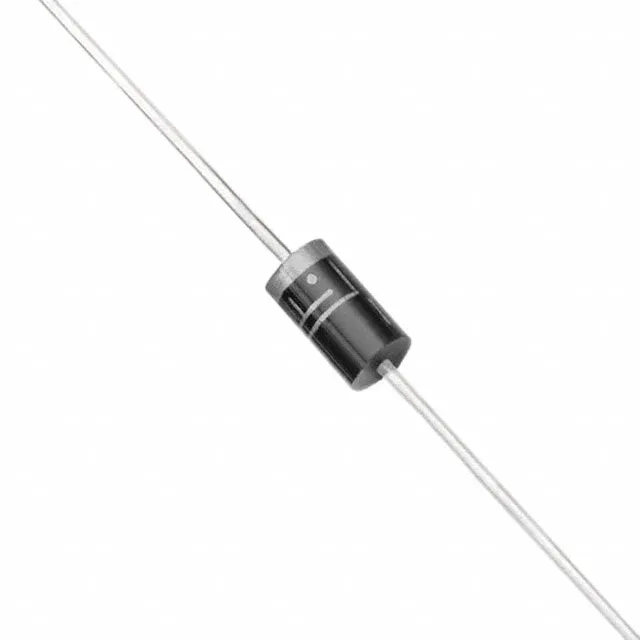
What the 1500W peak pulse rating means on the bench
The 1.5KE12C-B: That 1500W rating is the device's ability to absorb a transient without failing — it's not a continuous power dissipation figure. For a 10.2V reverse standoff voltage, the clamping voltage maxes out at 17.54V when the peak pulse current hits 91A, which is the current the part can shunt during that 10/1000µs event. The breakdown voltage range starts at 10.8V minimum, so the device begins conducting and clamping just above the 10.2V standoff level. This is a general-purpose transient suppressor — it has no power line protection rating, meaning it's intended for signal or low-energy DC rail clamping rather than mains AC protection.
Package and board-fit: DO-201 axial lead
Housed in a DO-201AA axial-lead package (also known as DO-27), the 1.5KE12C-B is a through-hole part with a single bidirectional die inside — one channel, two leads. The supplier device package is DO-201, and it's supplied in bulk, not tape-and-reel. On a repair bench, the axial form factor is easy to extract and replace with a soldering iron; the scorch mark on a dead board usually points right to it. The wide temp margin means the clamping voltage drift is predictable across the board's thermal profile.
Lifecycle reality: obsolete, sourced through surplus
Littelfuse lists the 1.5KE12C-B as Obsolete. No pin-compatible direct replacement is documented by Littelfuse, so a functional equivalent would need to match the 1500W peak pulse, 10.2V standoff, bidirectional configuration, and DO-201 footprint.