6.3 A fast-blow for tight board protection
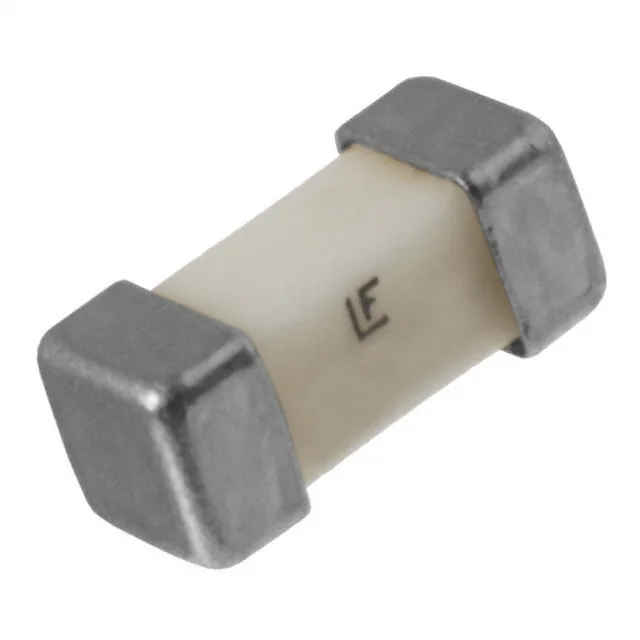
The Littelfuse 045106.3MRSN is a 6.3 A, 125 VAC rated fast-blow fuse from the NANO²® 451 series. Its 50 A breaking capacity at rated voltage means it can safely interrupt a short-circuit fault up to that current without rupturing — critical for protecting downstream traces and load components in a 125 VAC circuit. The 2-SMD square end block package (6.10 mm x 2.69 mm x 2.69 mm) is a standard surface-mount footprint. The 0.0096 ohm DC cold resistance keeps voltage drop low at rated current — about 60 mV at 6.3 A, which matters for low-voltage rails where every millivolt counts. Melting I²t of 9.17 tells you the energy needed to open the fuse. For inrush-limited loads like a capacitor bank on a DC-DC converter input, this number lets you check whether the fuse holds through the start-up surge without nuisance trips.
Active production with CSA, METI, UR approvals
Approvals from CSA, METI, and UR cover North American and Japanese regulatory acceptance. Available in Tape & Reel (TR) or Cut Tape (CT) packaging — the TR option is the standard production reel for pick-and-place assembly; CT is for prototyping or small-batch builds.
What the ratings mean for your BOM
The 6.3 A rating at 125 VAC is the continuous current the fuse carries without opening. For a 125 VAC line feeding a 6 A load, this fuse sits right at the nominal current — factor in ambient temperature derating if the board runs above 25°C, since the fuse element's thermal response shifts with the environment. Fast-blow response means it clears quickly on overcurrent — no intentional delay for motor-start or capacitive inrush. If your load has a high surge-to-steady-state ratio, compare the surge I²t against the fuse's 9.17 melting I²t to confirm margin. The 50 A breaking capacity at 125 VAC is the maximum fault current the fuse can safely interrupt. In a branch circuit with a prospective short-circuit current above 50 A, this fuse would not be the right choice — you would need a higher-interrupting rating or an upstream current-limiting device.