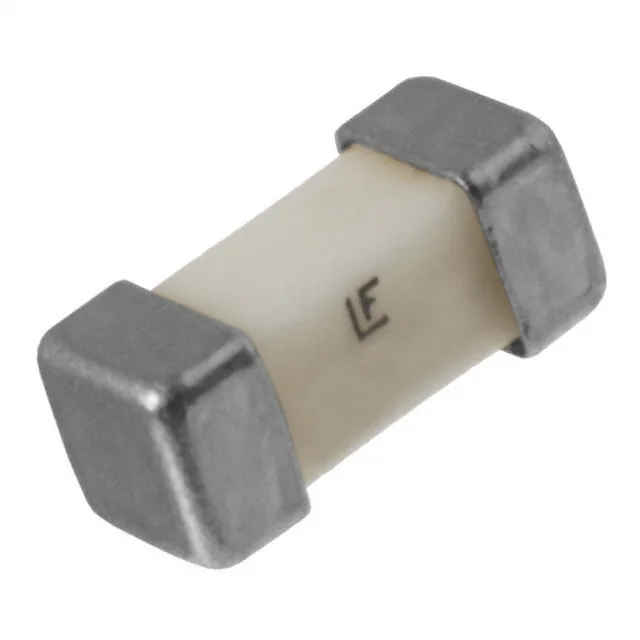
What the 15 A rating means for the board
The Littelfuse 0451015.NR is a 15 A fast-blow fuse in the NANO² 451 series, designed to open quickly on overcurrents before downstream silicon or PCB traces reach their thermal limits. Rated for 65 V on both AC and DC circuits, it fits common 48 V telecom, 24 V industrial, and 12 V automotive rails — the DC rating is the same as the AC rating, which simplifies BOM logic when the same fuse covers both domains. The 50 A breaking capacity at rated voltage means it can safely interrupt a fault current up to that level without rupturing the package — adequate for most secondary-side protection in equipment fed from a 10 A or smaller branch circuit.
Fast-blow response and I²t for inrush decisions
Fast-blow characteristic with a melting I²t of 97.82 — this is the energy the fuse element absorbs before opening. A downstream capacitor bank or motor start that draws a pulse above this threshold will nuisance-blow the fuse unless the pulse energy stays under the I²t rating.
Obsolete — sourcing reality for the 0451015.NR
For a BOM that already carries this fuse, the procurement path is through independent distribution channels where date-code provenance and lot traceability should be verified. No pin-compatible drop-in replacement is documented by the manufacturer; a parametric search for 15 A, 65 V, fast-blow, 2-SMD package fuses with comparable I²t and resistance will identify functional alternatives that require qualification testing.
Housed in a 2-SMD square end-block package measuring 6.10 mm x 2.69 mm x 2.69 mm — the rectangular body with end-cap terminations reflows like a chip resistor. The pad layout should match the manufacturer's recommended land pattern for the 451 series to keep the solder fillet height within spec and avoid tombstoning during reflow.
Compliance and approvals
Carries CSA and UL approval agency marks — both standards require the fuse to clear its rated current at 65 V without sustained arcing or case rupture. These marks are accepted in North American panel and equipment listings without additional component-level testing.