What the 2000 A rating and 210 kHz bandwidth mean for your BOM
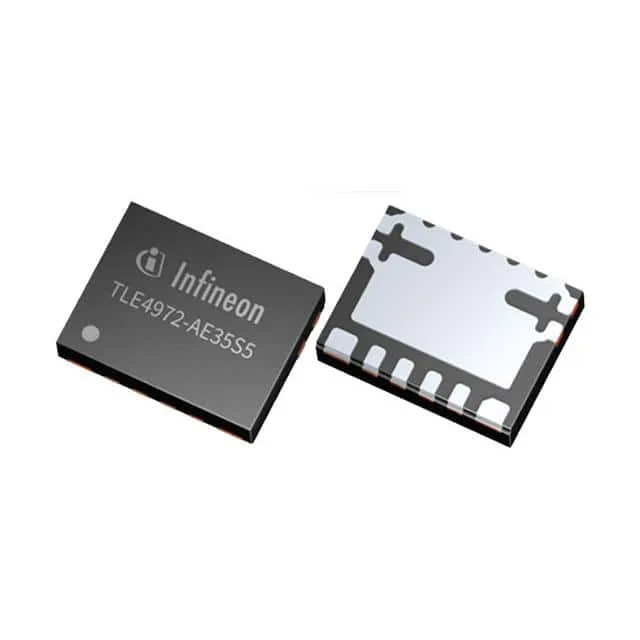
The TLE4972AE35S5XUMA1 is a differential Hall-effect current sensor that outputs a ratiometric voltage proportional to the sensed current, covering both AC and DC measurements up to 2000 A. That 2000 A figure is the maximum primary current it can measure — not the current it draws from your supply (which is 25 mA max). The 210 kHz bandwidth and 700 ns response time mean this sensor can capture fast transients and switching ripple in inverter or motor-drive phases, but the system-level bandwidth will also depend on the downstream ADC's sampling rate and anti-aliasing filter.
Supply voltage and output characteristics
The sensor operates from a 3.1 V to 3.5 V supply rail, drawing 25 mA max. The output is ratiometric — meaning the output voltage scales linearly with both the sensed current and the supply voltage. If your supply drifts, the measurement drifts with it, so a clean, regulated 3.3 V rail is the practical choice. Sensitivity is 62 mV/mT, which translates to a specific mV/A ratio depending on the primary conductor geometry (the datasheet provides the transfer curve).
The TLE4972AE35S5XUMA1 is RoHS3 compliant (no exemptions).