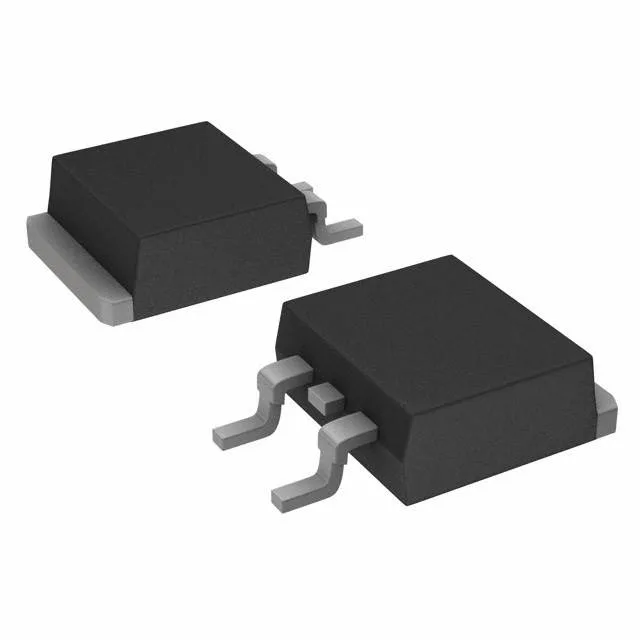
If the design can accommodate a pin-compatible alternative, the IRL540N (in D2PAK) is the same die in a different packaging variant and may be cross-shopped, but no direct replacement is guaranteed without verifying the gate charge and thermal performance against the original spec.
The 44 mOhm Rds(on) at 10 V gate drive sets the conduction loss: at 18 A, that is about 14 W dissipation in the channel, which the D2PAK tab must sink to a thermal plane. The 74 nC gate charge at 5 V is moderate — a 10 V gate drive with a 1 A source/sink driver switches it in roughly 74 ns, but the input capacitance of 1800 pF at 25 V drain-source means the driver sees a capacitive load that rises with drain voltage. The 2 V gate threshold ensures the device is fully enhanced with 3.3 V logic, but the Rds(on) at 4.5 V gate drive will be higher than the 44 mOhm figure — the datasheet curve (not reproduced here) typically shows a 1.5x to 2x increase below 5 V. For designs running from a 5 V rail, the logic-level threshold is a real advantage; for 3.3 V systems, verify the on-resistance at the actual gate voltage against the thermal budget.