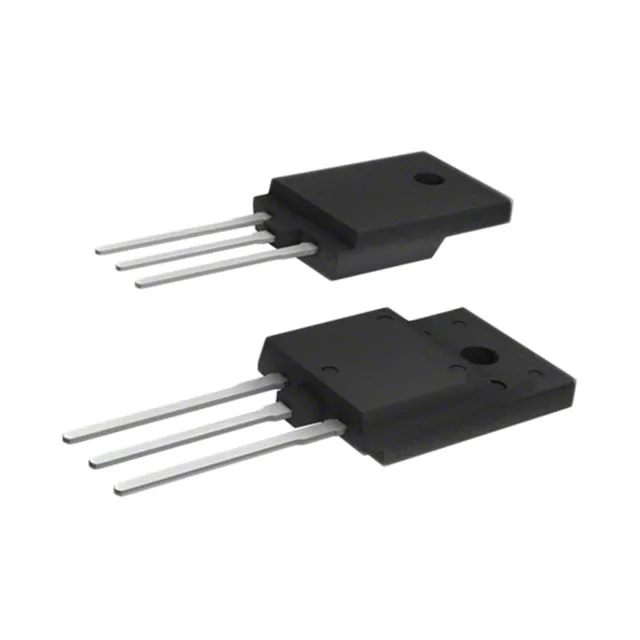
650 V, 280 mΩ, 13.8 A — the switching cell for PFC and flyback stages
It is built on the CoolMOS™ super-junction technology platform, which delivers low conduction and switching losses for hard-switching topologies.
Gate charge and switching — 45 nC keeps the driver budget reasonable
This keeps the gate-drive energy per switching cycle low enough that a standard bootstrap or isolated driver with a few hundred milliamps peak current can turn the device on and off within a few tens of nanoseconds. The input capacitance is 950 pF at 100 V drain-source bias, which sets the Miller plateau duration and the switching speed. For a 100 kHz PFC stage, the gate-drive losses stay under 50 mW with a typical 12 V driver supply — a non-issue for most designs.
Infineon still manufactures the device, but the official recommendation is to evaluate a successor for new projects. The NRND flag means the end-of-life notice could come at any point — buyers with long production runs should secure last-time-buy quantities or qualify an alternative before the EOL window closes.
Through-hole full-pack — no insulator needed, but watch the mounting torque
The PG-TO220-FP package is a through-hole, isolated full-pack variant of the standard TO-220. The metal tab is fully encapsulated in the moulding compound, so the device can be mounted directly to a grounded heatsink without an insulating pad or washer. This saves a BOM line and reduces thermal resistance compared to a non-isolated TO-220 with a silicone pad. The maximum power dissipation is 32 W at case temperature — derate linearly above 25°C. For continuous operation near the current limit, a heatsink with adequate surface area and airflow is required. Follow the recommended mounting torque (typically 0.4–0.6 N·m for the M3 screw) to avoid cracking the moulding.