50 MHz 8051 with programmable analog — the PSoC 3 sweet spot
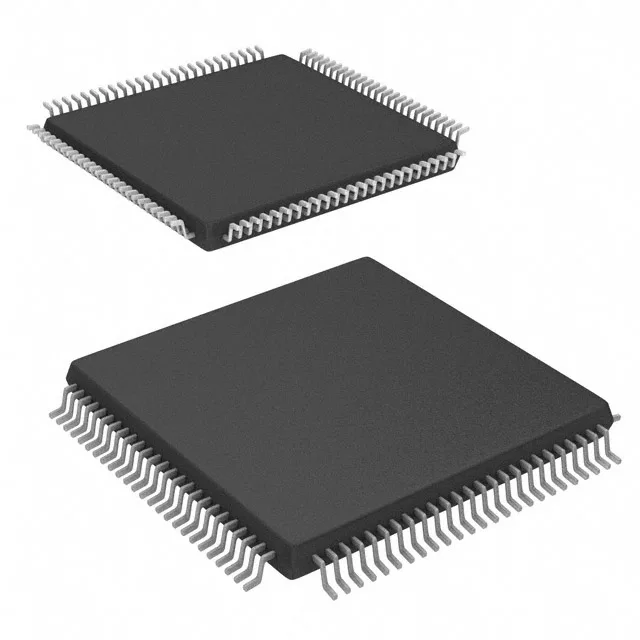
The Infineon CY8C3246AXI-131 is an 8-bit PSoC 3 microcontroller built around a 50 MHz 8051 core, packing 64 KB of Flash, 8K x 8 RAM, and 2K x 8 EEPROM into a 100-pin TQFP. What sets this part apart from a plain 8051 is the PSoC fabric: on-chip CapSense for touch interfaces, a 16-channel 12-bit ADC, an 8-bit DAC, LCD drive, and a programmable digital block array that lets you route PWM, timer, and UART peripherals without external logic.
62 I/O and a 100-pin TQFP — what the footprint demands
The 100-TQFP (14x14 mm body, 0.5 mm pitch) gives you 62 general-purpose I/O pins plus the dedicated power and ground pairs. That is a lot of signal for an 8-bit MCU — enough to drive a character LCD parallel bus, a row of CapSense buttons, and a handful of SPI sensors without I/O expanders. The 0.5 mm pitch means a standard two-layer board with 6/6 mil traces can route it, but the centre ground pad under the QFP needs a via stitch to the ground plane if you are pulling more than 100 mA through the core.
For a BOM that needs a proven 8-bit mixed-signal MCU without obsolescence risk, that matters: you are not chasing a sunset part through the broker channel. The ROHS3 compliance is current, so it passes EU and California reflow requirements as-is.
CapSense and the 12-bit ADC — where it saves a PCB rev
The integrated CapSense peripheral handles capacitive touch sensing without a dedicated controller chip — Infineon's own tuning software calibrates the sensitivity per channel. The 16-channel 12-bit SAR ADC runs at up to 1 Msps (typical) and can sample multiple analog inputs without an external mux. Pair that with the internal 1.71 V to 5.5 V regulator and you can power the analog block from the same rail as the digital core, simplifying the power tree. The 8-bit DAC is coarse but sufficient for a simple analog setpoint or a VCO tune voltage.
Industrial temperature and connectivity
No CAN interface on this variant; if you need CAN, step to the PSoC 5 family or add an external CAN transceiver on the UART.