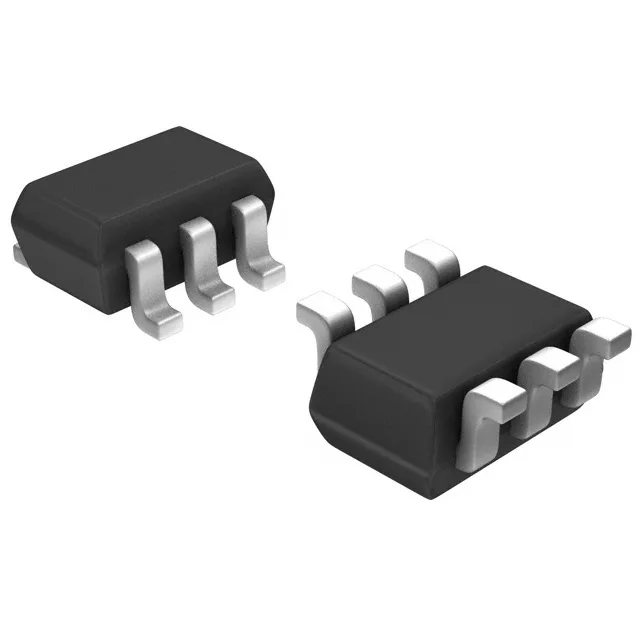
What this 4-channel steering TVS does on the board
The D5V0F4U6S-7 is a steering (rail-to-rail) TVS diode array from Diodes Incorporated, packing four unidirectional ESD protection channels into a single SOT-363 package. It clamps transients at 12V max (at 3A peak pulse, 8/20µs waveform) and holds a reverse standoff of 5.5V max, so it sits on 5V or 3.3V data lines without leaking. With an ultra-low 0.5pF capacitance per channel at 1MHz, it is sized for high-speed interfaces like HDMI and USB where signal integrity matters more than brute-force energy absorption.
The 5.5V max reverse standoff means the part stays off below that rail voltage — it will not load a 3.3V or 5V supply line with leakage current during normal operation. Breakdown occurs at a minimum of 6V, giving a 0.5V guard band above the standoff before the device starts conducting. Clamping at 12V max at 3A peak pulse (8/20µs) tells you the voltage the protected IC sees during a strike — if the downstream device has a 12V abs-max rating, this TVS keeps it inside the envelope. The 3A peak pulse current is rated on the 8/20µs waveform, the standard for IEC 61000-4-5 surge testing; for ESD events (IEC 61000-4-2) the part handles much higher instantaneous currents.
Housed in the 6-pin SOT-363 (SC-88), the part is a surface-mount device with a 0.65mm lead pitch — fits a standard 6-pin footprint shared by many logic and protection ICs. Power line protection is marked as supported — the rail-to-rail topology lets it clamp transients between the supply rail and ground, not just signal-to-ground.