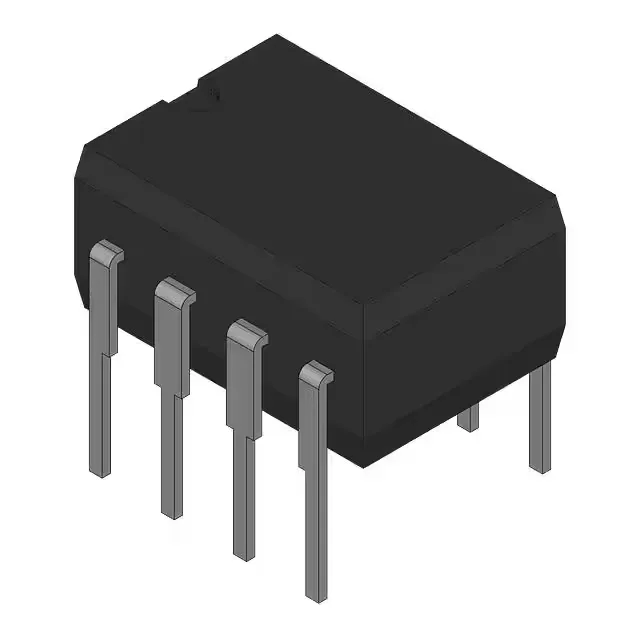
The OP64AZ/883C is a single-channel general-purpose op-amp from Analog Devices built for wideband analog signal conditioning. Its 80 MHz gain-bandwidth product and 170 V/µs slew rate mean it can handle fast pulse edges and high-frequency small signals without the slew-induced distortion that slower parts introduce. The 2.7 MHz -3 dB bandwidth confirms the wideband character — this is not a low-frequency precision amplifier, but a part for applications where signal fidelity at speed matters. Supply range spans 10 V to 36 V, giving headroom for ±5 V to ±18 V rails. Input offset voltage is 400 µV, input bias current 200 nA — adequate for many signal-chain roles, though not the ultra-low offset a precision op-amp would deliver.
Hermetic ceramic package — the reliability differentiator
This part ships in an 8-pin ceramic DIP (8-CDIP, 0.300" body width) with the die housed in a hermetic 8-CERDIP cavity package. That ceramic construction is the key differentiator from plastic SOIC or DIP variants: it seals the die against moisture and contaminants, which is why this package family appears in avionics, satellite payloads, missile guidance, and downhole instrumentation where a plastic package would risk reliability failures over a long mission life. Mounting is through-hole — the leads insert into a PCB and are soldered on the opposite side. No reflow profile to manage, but the ceramic body is more brittle than plastic; handle with care during insertion and avoid bending the leads at the glass seal. The bulk shipping form means parts arrive loose in a bag or tube, not taped for automated placement.
Military temperature range — deployment envelope
That covers cold-soak at altitude, engine-bay heat, and thermal cycling in unpressurized avionics bays. The 80 MHz GBW and 170 V/µs slew rate are guaranteed across this range, not just at 25°C — a critical distinction from commercial-temperature wideband op-amps that derate significantly above 85°C.
For a ceramic-package military-temperature op-amp, active lifecycle is notable: many parts in this class have been moved to NRND or EOL as fabs consolidate. This one remains available through the regular channel, which simplifies BOM planning for long-life defence and aerospace programs.
RoHS non-compliant — factor into assembly qualification
The part is RoHS non-compliant — the leads and internal construction use tin-lead solder, not lead-free. For defence and aerospace assemblies that are exempt from RoHS or that specify tin-lead for reliability in high-vibration environments, this is the preferred finish. For commercial or medical equipment that must meet RoHS, a lead-free alternative would be needed.