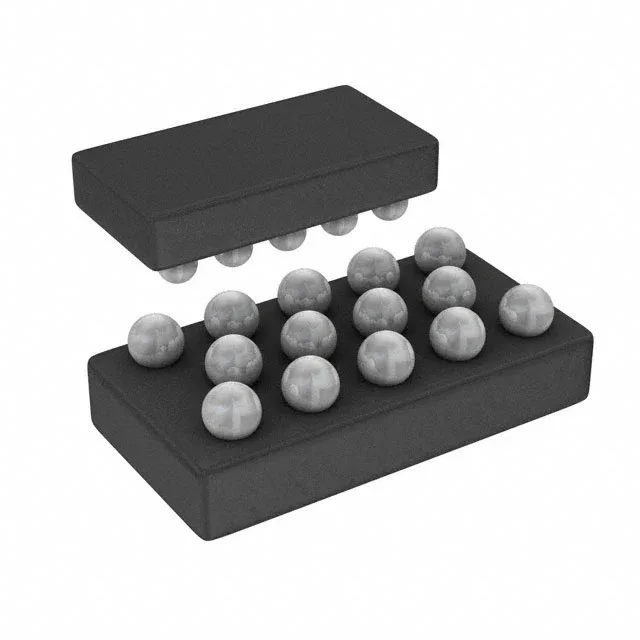
The Analog Devices OP482ACBZ-R7 is a quad JFET-input operational amplifier that packs four independent amplifiers into a 14-bump wafer-level chip-scale package (WLCSP) measuring just 1.128x2.123 mm. With a 4 MHz gain-bandwidth product and a 9 V/µs slew rate, it is designed for general-purpose signal conditioning, active filtering, and data-acquisition front ends where board space is at a premium and the signal path needs low input bias current — 3 pA typical. The supply range from 9 V to 36 V covers single-rail 12 V and 24 V industrial buses as well as dual ±5 V to ±18 V supplies, making it a flexible drop-in for multi-voltage systems.
The 9 V/µs slew rate supports full-power bandwidth up to roughly 140 kHz for a 10 V peak-to-peak output swing — adequate for audio, sensor conditioning, and control-loop filtering. The 4 MHz gain-bandwidth product means you can close a gain-of-10 stage and still have 400 kHz of closed-loop bandwidth. Compared to the ADA4000-4ARZ-R7 (20 V/µs, 5 MHz), the OP482ACBZ-R7 trades some speed for lower supply current: 210 µA per channel versus 1.4 mA per channel on the faster part. If your application needs less than 100 kHz signal content, the OP482 saves nearly 1.2 mA per amplifier — a meaningful difference on a four-channel part in a battery-powered design.
The WLCSP package does mean the part is moisture-sensitive — standard MSL handling and bake-before-reflow rules apply if the sealed bag has been opened.
14-WLCSP — board-area trade-off
The bumps are on a fine pitch typical of wafer-level packages; a 0.4 mm or smaller ball pitch is expected. For rework, hot-air reflow with a preheat zone below 150°C and a peak around 245°C is standard.