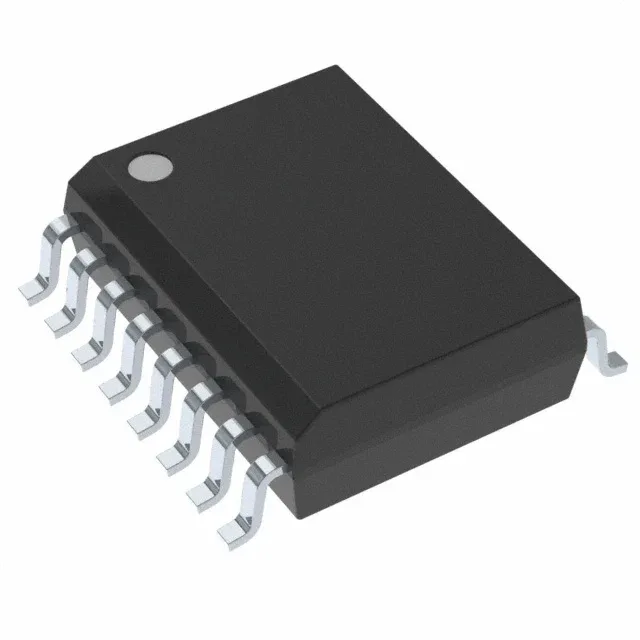
What the OP270GSZ-REEL brings to the board
It delivers a 5 MHz gain-bandwidth product and a 2.4 V/µs slew rate, with a maximum input offset voltage of 50 µV. Supply range spans 9 V to 36 V, covering both single-supply and split-rail configurations (±5 V to ±18 V). Each amplifier draws 4 mA quiescent current, keeping the total dissipation manageable in multi-channel signal chains.
The 5 MHz gain-bandwidth product supports closed-loop gains up to 100 with a 50 kHz small-signal bandwidth, adequate for precision sensor amplification, active filters, and data-acquisition front ends. The 2.4 V/µs slew rate gives a full-power bandwidth of roughly 38 kHz at 20 V p-p output, so fast-settling multiplexed ADC drivers and waveform generators stay within the linear region. The 50 µV input offset reduces the need for software calibration in DC-coupled paths — a real advantage when populating a multi-channel board where every microvolt of drift multiplies across channels.
Package and supply — fitting the 16-SOIC footprint
Supply range from 9 V to 36 V means the same part can run off a single 12 V or 24 V industrial rail, or from split ±5 V to ±18 V supplies. The 4 mA per amplifier supply current keeps the thermal rise low even in a densely populated board — no special heatsinking needed.
The ROHS3 compliance means the part is free of the ten restricted substances, including lead, and is suitable for EU-market equipment without exemption paperwork.