100 kHz GBP at 3.3 µA — the micropower trade-off
Its defining parametric pair is a 100 kHz gain-bandwidth product and a supply current of just 3.3 µA per channel — a combination that targets battery-powered or loop-powered sensor conditioning where every microamp counts.
28 V/µs slew rate — fast edges from a micropower amp
A 28 V/µs slew rate is unusually high for an op-amp drawing 3.3 µA. This means the OP181GP can handle fast pulse edges or moderate-frequency signals (up to roughly 45 kHz full-power bandwidth) without slew-rate limiting, while keeping the quiescent draw low. For comparison, the ADA4096-2WARMZ-RL offers a 786 kHz GBP but a much slower 0.4 V/µs slew rate and draws 100 µA per channel — a different power-vs-speed trade-off. The OP181GP's slew rate is closer to that of the 80 MHz ADA4841-2 (13 V/µs,), but at a fraction of the bandwidth and supply current. If your design needs to amplify a 10 kHz square wave with fast edges on a 3 V rail, the OP181GP's slew rate is the spec that makes it work where most micropower parts would slew-limit.
Note that the OP181GP is RoHS non-compliant — it is the tin/lead (SnPb) plated version intended for legacy, military, or high-reliability assemblies that require leaded solder. If your process requires RoHS compliance, check the OP181GPZ variant (if available) or plan for an exemption.
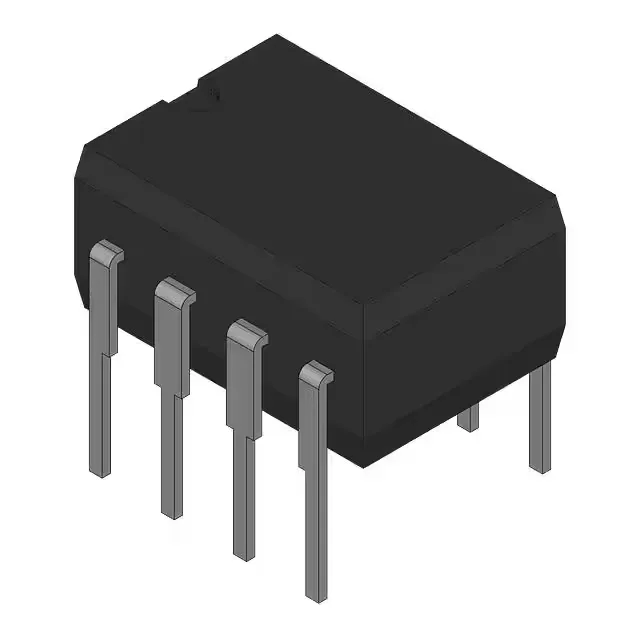
Through-hole DIP — board-level fit and rework
The OP181GP is supplied in an 8-DIP (0.300", 7.62 mm) plastic package with a 8-PDIP supplier device package designation. The mounting type is Through Hole. This package is straightforward for prototyping, breadboarding, and manual assembly. For production runs, the through-hole form factor means wave soldering or hand-solder rework; no reflow profile or moisture sensitivity level (MSL) to track. The 0.300" body width fits standard DIP sockets.