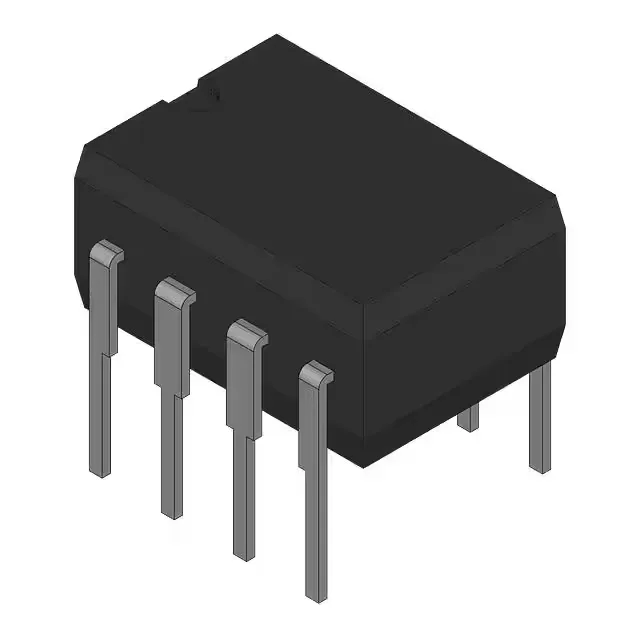
General-purpose op-amp in a ceramic DIP
The supply range spans 10 V to 44 V, accommodating split-rail or single-supply designs in bench instruments, audio preamps, and low-speed control loops.
At 0.5 V/µs, the OP02CZ's slew rate limits full-scale output swings to about 250 kHz for a 2 V peak-to-peak signal — fine for audio, low-frequency filtering, and DC-level shifting, but too slow for video or high-speed data acquisition. The 1.3 MHz gain-bandwidth product means a closed-loop gain of 10 reduces usable bandwidth to roughly 130 kHz. Input bias current of 1 nA keeps voltage offset from source resistance manageable — a 10 kΩ source adds only 10 µV of extra offset, which is negligible for most general-purpose circuits.
Supply voltage and package — design-in notes
Plan for at least ±5 V split rails or a single rail above 10 V. The CERDIP package offers better hermetic sealing and thermal cycling tolerance than plastic DIP, but it is heavier and costs more — a trade-off worth making for long-life or high-reliability boards where moisture resistance matters. Through-hole mounting means hand-assembly or wave-solder only; no reflow profile needed. The 8-pin DIP footprint is standard, with 0.100" pitch and 0.300" row spacing.
However, it is marked RoHS non-compliant, which restricts its use in new equipment placed on the EU market unless a specific exemption applies.