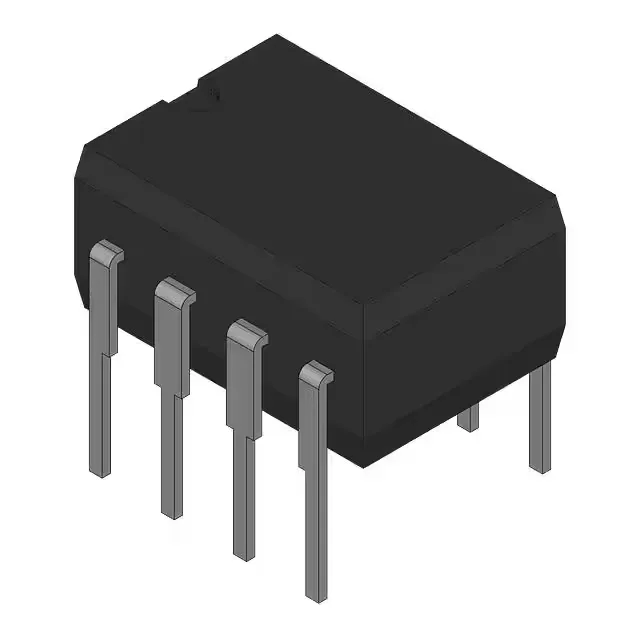
Single-supply general-purpose op-amp in an 8-DIP through-hole package
It delivers an 800 kHz gain-bandwidth product with a 0.25 V/µs slew rate, making it a fit for low-to-moderate frequency signal conditioning, active filters below 100 kHz, and DC precision loops where the 18 µV input offset voltage is the headline spec.
What the 700 µA input bias current means for your front-end design
The 700 µA input bias current is the spec that will trip up anyone expecting a modern JFET or CMOS input stage. With that much bias current, any source impedance above a few kilo-ohms will produce a voltage drop that swamps the 18 µV offset. This part works best when the source impedance is low — think voltage dividers off a stiff supply, current-sense resistors below 100 Ω, or as a buffer after an op-amp output. If you are conditioning a high-impedance sensor (a photodiode, a pH probe, a piezoelectric element), this is the wrong part; look for a FET-input op-amp instead.
That limits the MXL1001CN8 to indoor, climate-controlled environments — benchtop instruments, lab gear, office equipment, consumer audio, and similar.
Active lifecycle, but the package tells a story
That said, the 8-DIP through-hole package is a legacy form factor. New designs increasingly migrate to surface-mount packages (SOIC, MSOP, TSSOP) for automated assembly and board-density reasons. If your production line is purely SMT or you are targeting a compact PCB, this part forces a hand-insertion step or a wave-solder pass. The active status means it is still available through the independent distribution channel, but the long-term trend for through-hole op-amps is toward obsolescence. For a new BOM, consider a pin-compatible SOIC-8 version of the same amplifier if one exists in the family; for a legacy repair or a through-hole-only board, this is the direct fit.
RoHS non-compliant — check your assembly requirements
If your BOM requires RoHS compliance for EU market access or your own environmental policy, the MXL1001CN8 will not pass the materials declaration. For RoHS-sensitive builds, look for a lead-free (Pb-free) variant in the same family, or plan for an exemption if applicable.