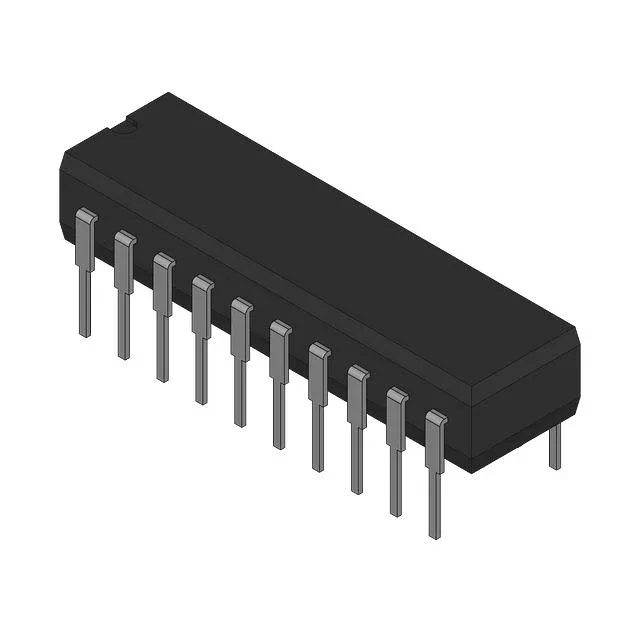
Dual 8-bit DAC in a hermetic ceramic package
The MX7528SQ is a dual 8-bit multiplying DAC in a 20-pin ceramic DIP (CDIP-20). It packs two independent R-2R DACs on one die, each with its own external reference input and current output, sharing a common 8-bit parallel data bus. The 350 ns settling time to ±½ LSB means each DAC can update at roughly 2.8 MSPS when driven by a clean write strobe — fast enough for waveform generation in the audio band or for servo-loop setpoint updates in a motion controller. The -55°C to 125°C operating range and the hermetic CDIP package qualify this part for avionics, satellite, downhole instrumentation, and other high-reliability environments where plastic packages are not accepted.
Supply rails and reference — three voltages required
The MX7528SQ needs three supply rails: a +5 V analog rail (4.75-5.25 V), a +5 V digital rail (4.75-5.25 V), and a +15 V rail (14.25-15.75 V) that biases the current-steering switches. The +15 V rail is mandatory — without it the DAC outputs do not swing correctly. The reference is external and must be able to drive the R-2R ladder input impedance, typically 5-10 kΩ. The output is current-unbuffered, so an external op-amp is required to convert the current to a voltage. The op-amp's input bias current and offset voltage directly affect the system accuracy. The digital interface is parallel: all 8 data bits are latched on a single write strobe. The data bus is shared between both DACs; the chip-select and write lines determine which DAC receives the data. No serial clock is needed, but the bus uses 8 digital I/O lines plus 2 control lines.
Linearity and monotonicity over temperature
The INL and DNL are both specified at ±1 LSB maximum. The DNL spec of ±1 LSB guarantees monotonicity — the output never decreases when the digital code increases. This is critical for closed-loop control systems where a non-monotonic DAC could cause the loop to hunt or oscillate. The ±1 LSB INL means the actual output can deviate from the ideal by up to one LSB at any code. For a 5 V reference, one LSB is 19.5 mV at the output of the I-V converter. This is the dominant error source in the analog path; the op-amp and reference must be selected to keep the total error budget below the system requirement.
RoHS non-compliant — verify end-market requirements
The MX7528SQ is marked as RoHS non-compliant. The CDIP package uses lead in the solder dip and the die-attach material. This part cannot be used in assemblies that must meet RoHS exemption-free requirements. Buyers should confirm the end-market RoHS directive before committing the BOM line.