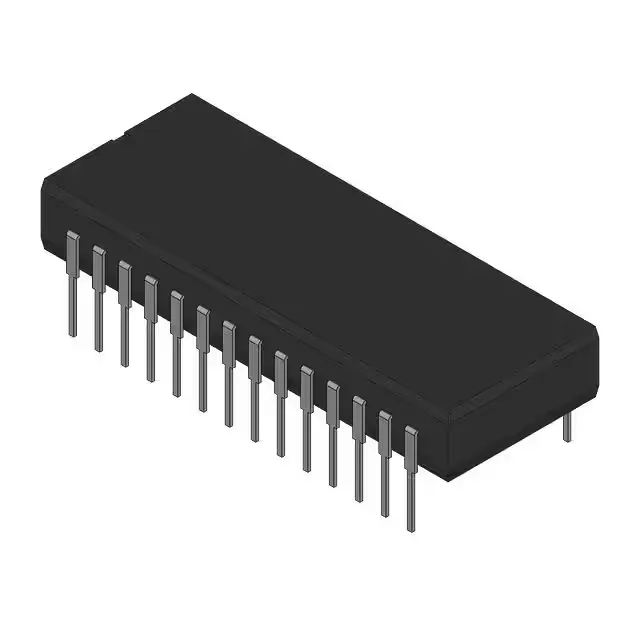
12-bit SAR ADC for legacy data-acquisition boards
The MX574AKEPI is a 12-bit successive-approximation-register (SAR) ADC from Analog Devices, sampling at 40k samples per second through a single-ended input. The 28-pin PDIP package (0.600-inch row spacing) and through-hole mounting mean this part fits socketed legacy designs or breadboard prototypes where a surface-mount ADC would require an adapter.
Sampling rate and interface — what the 40k SPS buys you
40k SPS is a moderate throughput — adequate for slow-moving signals like temperature, pressure, or strain-gauge outputs where the sensor bandwidth is under 2 kHz. The parallel data interface gives deterministic read timing without the latency of a serial bus, which matters when the host controller needs to capture the sample at a precise clock edge. The 1:1 S/H-to-ADC ratio means the internal sample-and-hold captures the input voltage once per conversion cycle; the acquisition time is already baked into the 40k SPS timing budget, so the external driver needs to settle within 25 µs to avoid missing the aperture. Single-ended input configuration keeps the pin count low — one analog channel per device — but the input range is referenced to the analog common, so the source must share the same ground reference without a differential rejection benefit.