80 ns propagation delay — what it buys the loop
Its 80 ns propagation delay (max) sets the upper bound for zero-crossing detection, overcurrent latch response, and PWM loop bandwidth — fast enough for most sensor threshold and signal-recovery circuits running below a few MHz. The CMOS, push-pull, or TTL output options let it drive logic inputs directly without a pull-up resistor, saving a BOM line.
The 600 µA max quiescent current per channel keeps the power budget tight for battery-powered or current-loop designs. Input offset voltage is 3 mV max at 5.5 V, and input bias current stays under 0.15 µA — both adequate for general-purpose threshold detection where sub-mV precision isn't required.
The 81.94 dB typical CMRR and PSRR reject common-mode and supply noise across the temperature range, so threshold accuracy holds up in electrically noisy environments where ground bounce or rail ripple is a given.
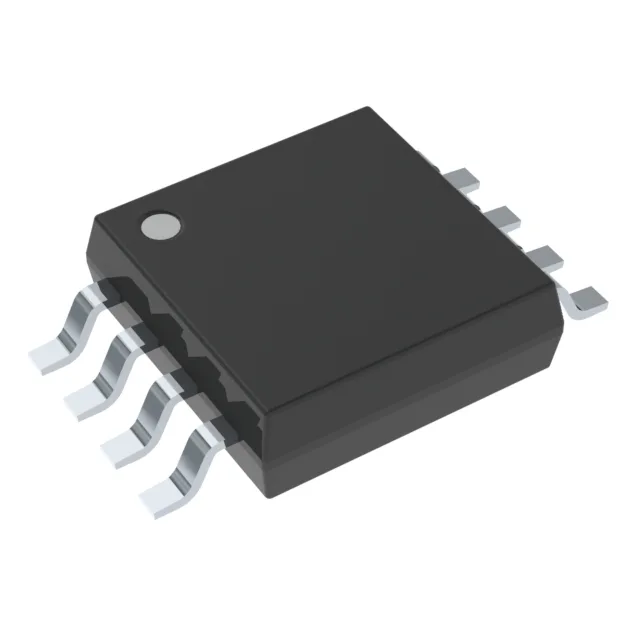
Package and rework — 8-uMAX/uSOP
The 8-MSOP/TSSOP footprint is common, and the body is small enough to fit tight layouts but large enough to hand-place and reflow without a microscope.